Testily.AI

Scaling QA for Fast-Growing SaaS Teams

Scaling QA

Scaling QA for Fast-Growing SaaS Teams Scaling a SaaS product is exciting. Scaling QA… not so much. Everything feels fine in the beginning. Small team, manageable releases, quick fixes. Then growth happens. More users. More features. More deployments, and slowly, QA starts falling behind. That’s the reality of scaling QA for fast-growing SaaS teams. This is usually when teams start exploring platforms like Testily.AI, which help scale QA workflows without adding more maintenance overhead. Where things start breaking Not immediately. At first, automation helps. Then: tests start failing randomly pipelines slow down debugging takes longer And suddenly, QA becomes the bottleneck even if no one planned it that way. At this stage, it’s usually not just about scale anymore. A lot of teams also start noticing tests behaving inconsistently, failing once and passing the next time, which makes debugging even harder than it should be. Tools like Testily.AI help reduce this instability by identifying flaky behavior early and improving consistency across test runs. What’s actually happening The problem isn’t effort. It’s scale. More features mean more test coverage. More integrations. More edge cases. Without a clear QA automation strategy, things grow… but not in a controlled way. That’s where scaling QA for fast-growing SaaS teams becomes difficult, and when that lack of structure continues, QA doesn’t just struggle to keep up; it slowly starts feeling like the slowest part of the entire delivery process. Testily.AI helps teams bring structure to this growth by reducing chaos in test automation and improving how testing scales alongside development. What teams usually try first Most teams respond by adding more tests. More scripts. More coverage. But that rarely fixes the issue. Because the problem isn’t quantity. It’s stability. What actually works Start earlier: Adopting practices similar to CI/CD testing helps reduce last-minute pressure. Fix automation, don’t just expand it: Weak automation creates more work over time. Reduce dependency on UI-heavy testing: UI tests are fragile. Balance them with API and unit tests. Improve collaboration: QA and dev working separately slows everything down. Where AI starts helping This is where platforms like Testily.AI start making a practical difference. Instead of constantly fixing tests, teams can reduce instability and improve automation reliability without increasing maintenance effort. What teams eventually figure out QA doesn’t break overnight. It slowly stops keeping up, and fixing it isn’t about adding more; it’s about changing how testing fits into the workflow. Interestingly, many teams hit this stage even after improving how early they test. Starting earlier helps, but keeping everything stable as the product grows is a different challenge altogether. Scaling your SaaS product but struggling to scale QA? Testily.AI helps you reduce flaky tests and keep your automation stable as your product grows. FAQs 1. Why does QA struggle in fast-growing SaaS teams? Because testing doesn’t scale at the same speed as development. 2. Does more automation solve the problem? Not always. Poor automation can create more maintenance. 3. What’s the biggest challenge? Keeping tests stable as the product evolves. 4. How can teams scale QA effectively? By improving strategy, not just increasing test volume. 5. Where does AI help? In reducing maintenance and improving test stability.

How to Test Before Code Exists (Shift-Left in Action)
How to Test Before Code Exists (Shift-Left in Action)

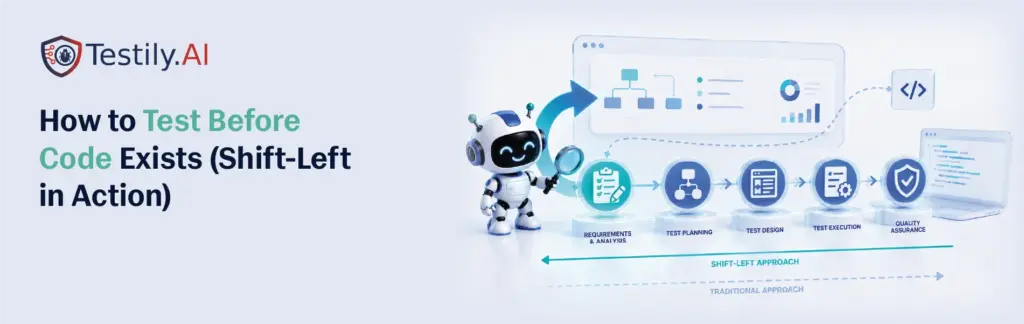
How to Test Before Code Exists: Shift-Left in Action In most FinTech teams, testing doesn’t fail because QA is weak. It fails because it starts too late. By the time code is ready, you’re already under pressure. Deadlines are close. Compliance checks are pending. And if something critical breaks, it’s not just a bug, it’s risk. That’s where shift-left testing starts becoming less of a “best practice” and more of a necessity. This is often where teams start exploring platforms like Testily.AI, which help bring testing earlier into the workflow without adding extra overhead. What testing looks like when you don’t shift left This is a pretty common pattern. A new feature gets planned, say, a payment flow update. Developers build it. QA waits for the build. Testing starts late in the cycle. And then: edge cases show up logic gaps appear flows don’t match real-world usage Now everything becomes urgent. Fixes, retesting, and coordination are all happening at the worst possible time. This is exactly what shift-left testing is trying to avoid. If this feels familiar, it’s usually not just about when testing starts. A lot of teams run into similar issues later when automation begins to behave unpredictably, especially when tests start failing without clear reasons. Tools like Testily.AI helps teams avoid this late-stage chaos by enabling earlier validation and reducing the pressure that builds up during final testing cycles. What changes when testing starts before code exists The first time a team tries this, it feels unusual. QA gets involved before development even begins. Not to “test” code but to understand what’s being built. In FinTech, this usually means: reviewing transaction logic questioning edge cases validating compliance scenarios thinking through failure states This is where shift-left testing actually starts inside discussions, not test environments. But even after moving testing earlier, some teams still feel like releases slow down at the final stage. That’s usually where the problem shifts from timing to the overall workflow structure. A real scenario most FinTech teams recognize A team was working on a recurring payments feature. On paper, it looked simple. But during the requirement review, QA pointed out: “What happens if the payment fails after partial processing?” That one question uncovered multiple gaps. Retries. Notifications. Data consistency. None of that was fully defined. That’s the impact of shift-left testing catching issues when fixing them is still easy. What improves when teams adopt shift-left testing It’s not dramatic. But it’s noticeable. Fewer late surprises Issues don’t pile up at the end. They get caught early in the software testing lifecycle. Less pressure during release When testing isn’t delayed, releases don’t feel rushed or risky. Better collaboration QA is no longer the “final step.” It becomes part of product thinking. Higher confidence in production Especially in FinTech, where mistakes are expensive, shift-left testing reduces uncertainty. Testily.AI supports this by helping teams maintain consistency between early-stage validation and later testing phases, reducing gaps across the software testing lifecycle. Where tools start helping without overcomplicating it Most teams already have: CI/CD testing pipelines QA automation setups What’s changing is how early these are used. platforms like Testily.AI helps teams apply shift-left testing more effectively by aligning QA with early-stage workflows instead of waiting for execution. This allows teams to validate requirements, identify risks earlier, and reduce the accumulation of late-stage issues. What teams eventually figure out Testing earlier doesn’t mean doing more work. It just means doing the right work sooner. In FinTech, that difference matters more than most industries. Because by the time code exists, the cost of mistakes is already too high. If you’re already involving QA earlier in discussions, the next step usually isn’t adding more tests; it’s figuring out how to keep everything manageable as systems grow. That’s where scaling QA and maintaining stability start becoming the bigger challenges. Trying to catch issues earlier in your release cycle? Testily.AI helps FinTech teams apply shift-left testing without increasing complexity or slowing down delivery. FAQs 1. What is shift-left testing? It means starting testing earlier in the development process, even before code is written. 2. Why is shift-left testing important in FinTech? Because bugs can lead to financial loss and compliance issues, catching them early is critical. 3. Does shift-left testing replace QA? No. It changes when QA contributes, not whether it’s needed. 4. How do teams start with shift-left testing? By involving QA in requirement discussions and early design stages. 5. Does it slow down development? No. It usually reduces delays later in the cycle.

End-to-End Testing with AI: A Practical Guide for 2026
End-to-End Testing with Al: A Practical Guide for 2026 Banner

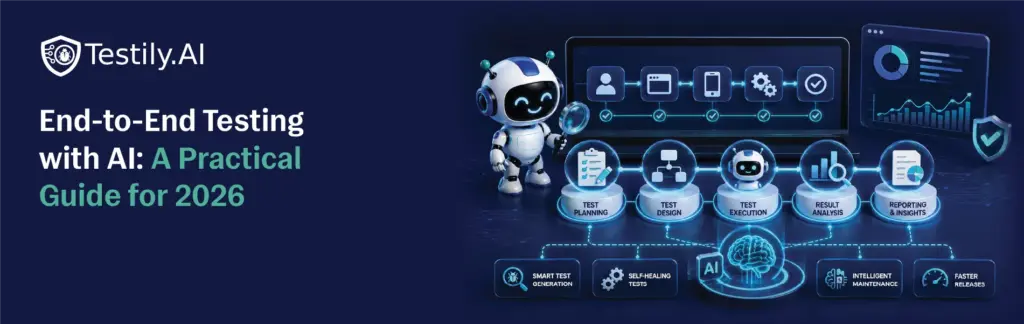
End-to-end testing always sounds better than it feels in real life. On paper, it’s simple. You run a full user flow, check everything from start to finish, and make sure nothing breaks. That’s the idea. But once you actually start doing it at scale, it becomes something else entirely. A small UI change breaks something random. A backend response shifts slightly. Some tests that used to run fine suddenly start failing “for no reason,” and you spend more time figuring out what broke the test than what broke the product. That’s usually when teams start looking at end-to-end testing with AI. Not because it’s trendy. More because they’re tired of fixing the same kind of failures again and again. This is usually when teams start exploring platforms like Testily.AI, which helps stabilize end-to-end tests and reduce repeated failures without constant manual fixes. E2E testing isn’t the issue… it just doesn’t stay stable Most teams don’t struggle to write end-to-end tests. That part is fine. The problem starts later when the product grows. Everything becomes connected in ways you don’t really notice at first. A locator that used to work suddenly doesn’t. A timing issue starts showing up only in CI. Test data behaves differently depending on the environment, and none of it feels serious individually. But together, it slowly turns into a maintenance problem. That’s what makes software testing automation feel heavier over time. Tools like Testily.AI helps reduce this maintenance overhead by adapting to small changes and keeping test flows stable as systems evolve. So what actually changes with AI? Honestly, not as much as people expect at first. You’re not replacing your framework. You’re not rebuilding your tests. The main change is simple tests don’t break as easily for small, stupid reasons. If something shifts slightly in the UI, the test doesn’t immediately fall apart, and when something does fail, it usually gives a bit more context instead of just “expected vs actual.” It sounds small, but in real QA work, that saves a lot of time. That’s where end-to-end testing with AI quietly starts making a difference. That’s where platforms like Testily.AI start making a practical difference by reducing unnecessary failures and improving test stability without adding extra maintenance work. Where you actually feel it in day-to-day work It’s not dramatic. It’s not like everything suddenly becomes perfect. It’s more like… fewer annoying interruptions. Fewer random failures that don’t mean anything You know those failures where nothing is actually broken? A button moved a few pixels. A class name changed. Something cosmetic, and suddenly 5 tests are red. With end-to-end testing with AI, those things don’t always blow up the suite anymore. Some tests just adjust or don’t fail unnecessarily. So the pipeline feels calmer. Less noisy. Debugging gets slightly less painful E2E debugging is usually frustrating because you don’t know where to start. Was it timing? Was it data? Was it real? You end up rerunning things just to understand the failure. AI doesn’t magically fix that, but it does help narrow things down a bit. Even that small improvement reduces a lot of everyday test automation challenges. Testily.AI supports this by identifying failure patterns and helping teams understand whether issues are real bugs or test instability. Tests don’t go out of date as fast This is something people underestimate. The product keeps changing, but tests don’t always keep up. After a while, you’re testing old behavior without realizing it. With end-to-end testing with AI, tests don’t drift as quickly because they adapt better when things change slightly. Maintenance slowly stops eating your time This is probably the biggest one. Instead of constantly fixing broken tests, you start spending more time actually looking at meaningful failures. Not everything disappears, obviously. But the constant firefighting reduces, and that’s where a good QA automation strategy actually starts feeling real instead of theoretical. How teams usually start using it Nobody flips a switch and changes everything. It usually starts with one painful area. A checkout flow that keeps breaking. A login test that fails randomly. A regression suite everyone avoids running on Friday. That’s where end-to-end testing with AI gets introduced first. Not everywhere. Just where things hurt the most. If it works there, teams slowly expand it. The part nobody says out loud AI doesn’t fix bad testing habits. If your test design is messy or your environments are unstable, you’ll still have problems. That doesn’t go away. What changes is how often you deal with the same issues. Instead of fixing the same flaky test every week, it shows up less frequently. That’s really the practical value of AI testing here. Where Testily fits in Testily.AI sits in that “reduce the pain” space. It’s not trying to replace QA teams or rewrite how testing works. It just helps with things like: reducing flaky test failures keeping E2E flows more stable handling small changes without constant fixes Basically, less time fixing tests, more time actually testing. What Teams Eventually Figure Out End-to-end testing was never the problem. It just doesn’t stay stable as systems grow, and that’s where most of the frustration comes from. Not writing tests… but maintaining them. With end-to-end testing with AI, things don’t become perfect. They just become less chaotic. Fewer false failures. Less guessing. Less time wasted on things that don’t really matter, and slowly, testing starts feeling manageable again instead of something that’s always behind. If your team is spending more time fixing E2E tests than trusting them, that’s usually the real signal. Struggling with unstable end-to-end tests? Testily.AI helps you reduce flaky failures and keep your test suites reliable as your product evolves. FAQs 1. What is end-to-end testing with AI? It’s just E2E testing where AI helps reduce unnecessary failures and makes tests more stable when the application changes. 2. Why do E2E tests break so often? Mostly because they depend on UI, timing, and data and all of that keeps changing in real projects. 3. Does AI stop

How AI Testing Can Reduce Test Maintenance by 70% and Why Teams Are Paying Attention
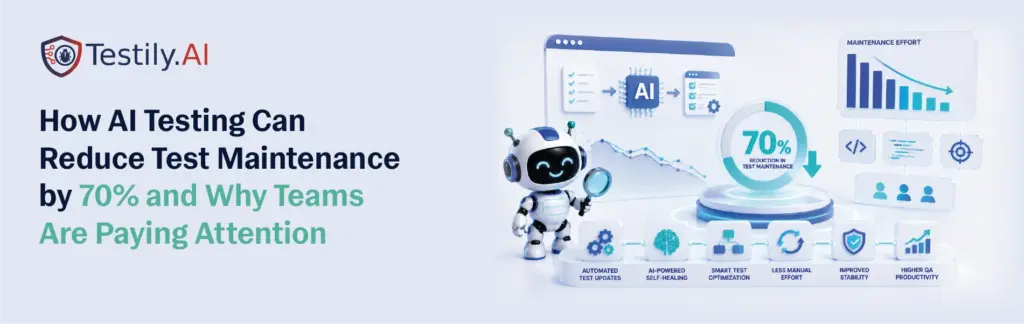
How AI Can Reduce Test Maintenance by 70% and Why Teams Are Finally Paying Attention

At some point, maintaining tests becomes the real work Most teams don’t feel the pain at the beginning. Automation feels like progress. Tests run. Pipelines look stable. Everything seems under control. But slowly, things change. A few tests fail. You fix them. Then more breaks, and without realizing it, your effort shifts from building coverage… to maintaining it. That’s usually when teams start seriously exploring AI testing not as a trend but as a way to reduce test maintenance by 70% and escape constant firefighting. The real issue isn’t automation; it’s what comes after Automation works. It runs tests. It improves coverage. But it also creates something teams don’t fully plan for: maintenance overhead. Every small change leads to: Broken locators Unstable runs Repeated debugging And this becomes routine. This is where AI starts making a practical difference by reducing the ongoing effort that automation creates. What actually changes with AI testing AI doesn’t replace your framework. It changes how much effort it needs. Tests become less fragile. Failures become clearer. Fixes take less time. That’s where teams begin to see how AI testing can reduce test maintenance by 70% in real workflows, not just in theory. Where teams feel the impact first 1. UI changes stop breaking everything Small UI updates no longer cascade into failures. Tests adapt. This is often the first sign that AI is working. 2. Failures become meaningful Instead of guessing: Is it flaky? Is it real? AI testing helps identify patterns. Which means less time debugging and more time fixing real issues. 3. Test suites stay aligned with the product Normally, tests lag behind product changes. With AI , they evolve alongside it. That alone significantly reduces maintenance effort. 4. Flaky tests stop dominating your time Flaky tests are one of the biggest hidden costs. They: Fail randomly Pass on reruns Kill trust AI testing reduces this instability by learning from patterns. This is where teams most clearly experience up to a 70% reduction in maintenance effort. What “70% reduction” actually means Let’s keep it real. It doesn’t mean Zero maintenance Zero debugging Fully autonomous QA It means: Fewer repetitive fixes Less debugging time More stable runs Reduced daily firefighting In simple terms: You stop solving the same problem repeatedly. How teams adopt AI testing (without disruption) No big overhaul. Most teams start small: Flaky test suites Regression packs High-maintenance flows Then introduce: Self-healing tests Failure pattern detection Intelligent updates That’s how AI testing scales gradually and safely. A quick reality check AI testing is powerful but not magic. If: Test design is weak Requirements are unclear Processes are messy Then AI will only optimize inefficiency. The best results come when AI supports a solid QA foundation. Why teams are paying attention now Earlier, maintenance was tolerated. Now it’s a problem. Because: Releases are faster CI/CD is constant QA cycles are shorter In this environment, AI isn’t optional anymore; it’s practical. Where Testily.AI fits in This is exactly what platforms like Testily.AI focuses on. Instead of replacing your system, it helps: Reduce repetitive maintenance Stabilize automation Keep tests aligned with changes So your team can focus on quality not upkeep. Why this shift matters Automation was supposed to reduce effort. But for many teams, it just shifted effort to maintenance. With AI testing, that balance starts correcting itself. Less fixing. More building. Better releases. FAQs 1. What is AI testing? AI testing uses machine learning to improve test stability, reduce maintenance, and adapt to changes automatically. 2. Can AI testing really reduce maintenance by 70%? Yes, especially in high-maintenance environments with flaky tests and frequent UI changes. 3. Does AI testing replace QA teams? No. It removes repetitive work so teams can focus on higher-value tasks. 4. How does AI testing handle flaky tests? It identifies patterns and reduces instability across runs. 5. Is it difficult to implement? No. Most teams start with a small, high-impact area.

How to Generate Test Cases from Requirements Automatically (2026 Guide)

Test cases

At some point, writing test cases just starts slowing everything down You don’t really notice it in the beginning. Writing test cases feels simple enough. You read a requirement, understand the flow, and document scenarios. It works fine. But as the product grows, something changes quietly in the background. Requirements don’t stay stable. They change mid-sprint. Features evolve faster than documentation. And suddenly, you’re spending more time updating test cases than actually using them. That’s usually when teams start wondering if there’s a better way to handle it, and the idea to generate test cases from requirements automatically stops sounding like theory and starts feeling practical. This is usually when teams start exploring platforms like Testily.AI, especially when test case creation begins taking more time than actual testing. The real problem isn’t writing test cases; it’s keeping them updated Writing a test case once isn’t the hard part. The problem is everything that comes after. Every feature change means revisiting old scenarios. Every update means rewriting parts of your test suite. Every edge case discovered late means going back again. Over time, it stops feeling like testing and starts feeling like maintenance. That’s why teams begin looking at ways to generate test cases from requirements automatically,  not to replace effort but to reduce repetition. Tools like Testily.AI helps reduce this cycle by keeping test cases aligned with changing requirements without constant manual updates. So what does this actually look like in real work? It’s less complicated than it sounds. Instead of starting with a blank document, AI testing tools read the requirement and suggest test scenarios based on it. When you generate test cases from requirements automatically, you usually get a first draft that includes the following: basic test scenarios suggested steps expected outcomes You still review everything. You still adjust based on context. But you’re no longer building everything from scratch each time. That shift alone changes how QA teams operate. Platforms like Testily.AI make this process smoother by generating structured, usable test cases directly from requirements with minimal setup. Where this actually starts making a difference When requirements keep changing This is probably the most common scenario. Instead of rewriting everything manually, teams just generate test cases from requirements automatically again and refine the output. It keeps pace with fast-moving development without starting over each time. When coverage starts becoming inconsistent Even experienced QA teams miss scenarios sometimes. This is where intelligent testing helps; it picks up patterns and edge cases that are easy to overlook during manual writing. When teams start scaling A growing product means a growing test suite, and manual effort doesn’t scale at the same speed. That’s where software testing automation starts becoming a necessity rather than an option. This is where Testily.AI helps teams scale test case creation without proportionally increasing manual effort. How teams actually make this work (without over complicating it) Most teams assume this needs a big transformation. It doesn’t. It usually comes down to a few practical shifts. Start with clearer requirements This matters more than any tool. If requirements are unclear, even the best system will struggle. But when user stories are structured properly, it becomes much easier to generate test cases from requirements automatically in a meaningful way. Use tools that understand context, not just keywords Modern AI testing tools don’t just scan text they try to understand intent. That’s what makes test case generation actually useful instead of mechanical. Keep structure consistent Even when test cases are generated, structure still matters. Naming, formatting, and prioritization keep things usable as the suite grows. Always review the output Automation helps, but it doesn’t replace thinking. Good QA teams don’t skip reviews; they just spend less time writing and more time validating what’s generated. That’s the balance when you generate test cases from requirements automatically. Make it part of your workflow The real value comes when this isn’t a one-time activity. Requirements change → test cases update; new features → test cases are generated again. That’s when QA automation starts reducing real workload instead of just adding tools. What teams usually notice first Most teams expect speed improvements, and they do get that. But the bigger changes are usually the following: fewer missed scenarios more consistent coverage less back-and-forth between dev and QA Over time, testing feels less reactive and more controlled. That’s the real impact of being able to generate test cases from requirements automatically. A quick reality check This isn’t magic. There are still things that can go wrong: unclear or incomplete requirements over-reliance on generated output skipping validation and review The goal is not to remove humans from QA. It’s to remove repetitive effort that doesn’t need human time. Where this is heading Testing is clearly moving toward: faster release cycles continuous validation reduced manual repetition And in that shift, the ability to generate test cases from requirements automatically is becoming a core part of modern QA workflows. Where Testily.AI fits in This is where Testily.AI fits naturally into the process. Instead of manually building every test case, teams can: generate test cases directly from requirements keep test coverage aligned as requirements change reduce repetitive test creation effort It doesn’t replace QA thinking. It just removes the repetitive groundwork. Writing test cases isn’t the problem Writing test cases isn’t the hard part. Keeping them updated as everything changes is what creates friction. When teams can generate test cases from requirements automatically, that friction drops significantly. Platforms like Testily.AI supports this shift by reducing manual effort and helping QA teams stay aligned with fast-moving development without falling behind. Struggling to keep test cases updated as requirements change? Testily.AI helps you generate, manage, and scale test cases automatically without increasing manual effort. FAQs 1. What does it mean to generate test cases from requirements automatically? It means using AI testing tools to convert requirements into structured test scenarios without manual writing. 2. Is AI reliable for test case generation? It is reliable for drafts and suggestions, but

Top 10 Challenges in Software Testing and How Teams Actually Deal With Them

Top 10 Challenges in Modern Software Testing and How Teams Actually Deal With Them

Testing didn’t suddenly become harder… It just stopped being predictable. If you’ve been in QA for a while, you’ll probably relate to this. Earlier, things felt slower, more controlled. Releases had gaps. Testing had time. Now? Everything moves at once. Features ship faster, updates don’t really “wait,” and software testing is expected to keep up without slowing anything down. That’s where most challenges in testing actually begin. Not because teams don’t know how to test, but because the environment around testing has changed completely. When speed increases, software testing starts feeling squeezed One of the first things teams notice is time disappearing. There’s always something “almost ready,” something “just pushed,” something that “needs quick validation.” And before you realize it, software testing is happening in between things instead of being a proper phase. That’s when small issues stop being small. Flaky tests quietly break trust You’ve probably seen this happen. A test fails. Nothing changed. You rerun it… it passes. At first, it’s annoying but manageable. Over time, it becomes something else entirely people stop trusting results, and once that happens, even good software testing loses its value because now every failure needs validation. Automation starts feeling like maintenance, not progress Automation is supposed to make life easier. But in many teams, it slowly turns into something you constantly have to fix. Selectors break. Flows change. Scripts need updates… again, and suddenly, instead of improving testing, automation becomes its own workload. That’s one of the most common turning points teams hit. Software testing becomes the bottleneck without anyone planning it No team sets out thinking, “Let’s slow down QA.” It just happens. Development keeps moving. Testing gets pushed later. Everything piles up. And now software testing is under pressure to validate everything quickly. That’s how bottlenecks form: not from inefficiency, but from timing. UI-heavy testing creates more problems than it solves UI testing feels right because it mimics real users. But it’s also the most fragile part of testing. A small UI change can break multiple tests. And over time, teams spend more effort fixing tests than actually learning anything from them. That’s when you start questioning whether all that coverage is actually helping. Automation without structure becomes confusing More tests don’t always mean better testing. In fact, without structure, they usually mean more chaos. Different naming styles, inconsistent logic, unclear coverage it all adds up. And suddenly, your software testing system feels harder to manage than the product itself. Environments make everything harder than it should be This one frustrates almost everyone. A test works locally. Fails in CI. Then passes later without changes. Now you’re stuck figuring out if it’s: the environment the data or the test itself A lot of hidden friction in software testing comes from this inconsistency. Failures don’t always explain themselves A failed test should tell you something useful. But often, it doesn’t. You’re left guessing: Is this a real bug? Is it flaky? Should I rerun it? That uncertainty slows everything down and adds unnecessary effort to everyday software testing. Scaling software testing isn’t as simple as adding more tests When products grow, teams usually respond by increasing coverage. But software testing doesn’t scale linearly. More services → more dependencies More features → more edge cases Without structure, scaling just creates more complexity, not better quality. Every team is trying to balance the same three things At the end of the day, it always comes down to this: Move faster Maintain quality Keep things stable And trying to balance all three is where most software testing challenges actually show up. What teams that manage this well do differently There’s no perfect system, but there are patterns. Teams that handle software testing well usually: Start testing earlier (not at the end) Don’t rely only on UI tests Keep automation structured, not just expanded Focus on reducing maintenance, not just adding coverage And increasingly, they’re using AI in practical ways not to replace testing, but to reduce repetitive effort. A pattern you see in almost every growing team At some point, teams realize something uncomfortable: A lot of sprint time is going into fixing tests… not building features. That’s usually the turning point. Once they simplify their approach to software testing and reduce over-dependence on fragile automation, things start feeling manageable again. Testing didn’t break… it just didn’t keep up Software testing didn’t fail. It just didn’t evolve at the same pace as development. The teams that are doing well today aren’t avoiding challenges; they’re adjusting how testing fits into their workflow, and that’s the real shift. FAQs 1. What are the biggest challenges in software testing today? Flaky tests, maintenance overhead, scaling issues, and inconsistent environments are some of the biggest challenges in software testing. 2. Why does software testing feel harder now? Because development cycles have become faster, but testing processes haven’t always adapted at the same speed. 3. What are flaky tests? Tests that fail randomly without any actual change in the code. 4. How does automation create challenges? Poorly structured automation increases maintenance effort and reduces trust in test results. 5. Can AI improve software testing? Yes, especially in reducing repetitive work, identifying unstable tests, and improving overall efficiency.

Why QA is the Biggest Bottleneck in Software Delivery

Why QA is the Biggest Bottleneck in Software Delivery

Everything feels fast… until testing shows up Most teams don’t really notice it at first. Development is moving. Features are getting shipped. Deployments look smooth and frequent, and then at some point, things just… slow down. Not during development. During testing. That’s usually when people first start noticing software testing bottlenecks not as a failure but as a pattern that keeps repeating before every release. It’s rarely actually a QA problem This is where most assumptions go wrong. When delays happen, QA often gets blamed first. But in most real setups, QA is just where everything finally shows up. The real issue is usually how work flows through the system. Features get built first. Testing happens later, and everything that was unclear, incomplete, or rushed earlier suddenly lands in one place. That’s how software testing bottlenecks actually form not because QA is slow, but because testing is positioned too late in the process. Why QA ends up feeling overloaded If you talk to most QA teams, the experience sounds pretty familiar. Everything feels fine until it suddenly doesn’t. Testing starts late, and by then there’s already pressure to release. So instead of slowing down and investigating properly, everything becomes time-bound. Manual testing makes it harder to keep up as speed increases. It still works, but it doesn’t scale with modern release cycles. Automation is usually there too, but often it’s not structured well. So instead of helping, it creates its own maintenance load, and then there’s the hidden one: unstable environments and inconsistent test data. Tests fail, reruns pass, and nobody is fully sure why. Over time, all of this starts stacking up as test automation challenges, even if nobody labels it that way at the beginning. What it feels like in real delivery cycles It doesn’t look dramatic. It looks like this: A release that was “almost ready” yesterday suddenly needs more fixes. QA cycles extend by a day or two. Teams start waiting on test results before making decisions, and slowly, testing becomes the point where momentum breaks. That’s when software testing bottlenecks become visible in everyday work. What actually helps and it’s usually not complicated The fixes are rarely about adding more tools or more tests. It usually starts with changing when testing begins. When testing starts earlier, even slightly earlier, things already behave differently. Issues don’t pile up as much. QA doesn’t get flooded all at once. That’s the basic idea behind shift-left testing, and most teams underestimate how much difference it makes until they try it. Another shift is treating testing as something continuous instead of something that happens at the end. When testing is spread throughout development instead of concentrated at the end, pressure naturally reduces. That’s what continuous testing really solves in practice. Automation also needs attention, but not in the “add more tests” way. Most teams don’t need more automation; they need cleaner automation. Something maintainable, structured, and not tightly coupled to every small UI change. That’s where a proper QA automation strategy matters more than coverage numbers. Where AI actually fits into this AI doesn’t replace QA or magically remove bottlenecks. But it does help reduce some of the repetitive work that slows teams down. Things like identifying unstable tests, reducing maintenance effort, and improving test coverage visibility are where AI in testing is becoming useful in real workflows. Tools like Testily.AI fits into this space not by changing how QA works completely, but by reducing the noise that builds up around it. So is QA really the bottleneck? Not really. QA is just where the slowdown becomes visible. The actual bottleneck is usually earlier in how work is planned, how testing is introduced, and how aligned teams are while building features. Once that changes, software testing bottlenecks don’t disappear instantly, but they stop being a constant pattern. Why QA Only Looks Like the Bottleneck When teams say QA is slowing everything down, it usually sounds like a people problem. But in most cases, it isn’t. It’s a timing problem. If testing always happens at the end, it will always feel like a bottleneck. But when it becomes earlier, continuous, and more connected to development, QA stops acting like a blocker and starts acting like a stabilizer. That’s usually the real shift teams are looking for even if they don’t phrase it that way. What’s starting to change now is how much effort testing actually needs to keep working. Instead of systems that constantly require fixing, teams are slowly moving toward setups that stay stable as the product evolves. That’s also where platforms like Testily.AI are beginning to fit in not by adding more tests but by reducing the maintenance and noise that usually builds up around them, and when that noise goes down, QA doesn’t feel like a bottleneck anymore. It just becomes part of the flow. FAQs 1. What are software testing bottlenecks? They are delays in the testing phase that slow down software delivery and release cycles. 2. Why does QA become a bottleneck? Mostly because testing happens late, automation is not structured well, or environments are unstable. 3. How does shift-left testing help? It brings testing earlier into development so issues are caught before they pile up. 4. What role does automation play? Automation helps reduce effort, but without structure it can also create maintenance overhead. 5. How does continuous testing help? It spreads testing across the entire development cycle instead of concentrating it at the end. 6. Can AI improve QA bottlenecks? Yes, AI in testing helps reduce repetitive work and improve stability in testing workflows.

The Hidden Cost of Flaky Tests in CI/CD

Why Your Test Automation Keeps Breaking (And How to Fix It)

Not every failed test actually means something is broken If you’ve worked with CI/CD pipelines for even a short time, you’ve probably seen this. A test fails. Nothing in the code changed. You rerun it… and it passes. At first, it doesn’t feel like a big deal. Just rerun and move on. But over time, this starts happening more often. And that’s when things quietly begin to slow down. Not in an obvious way. Just enough that your CI/CD flow starts feeling… unreliable. What flaky tests actually look like in CI/CD Flaky tests are simple to describe, but frustrating to deal with. They pass sometimes. Fail sometimes, and don’t give you a clear reason why. In a CI/CD setup, where everything depends on fast and reliable feedback, that inconsistency becomes a real problem. Because now, every failure raises a question: “Is this real… or do I rerun it?” The hidden cost most teams don’t notice Flaky tests don’t break things instantly. They create friction slowly. 1. CI/CD pipelines start slowing down One rerun doesn’t matter. But multiple reruns across builds? That adds up quickly. Your CI/CD pipeline starts taking longer, not because of complexity but because of uncertainty. 2. People stop trusting the pipeline This is where it gets serious. If failures aren’t reliable, developers stop reacting to them. They rerun first. Investigate later, and once that habit forms, your CI/CD system stops being a source of truth. 3. Debugging becomes a time sink You end up spending time chasing issues that don’t exist. Was it: a real bug? a timing issue? an environment glitch? That confusion is one of the biggest hidden costs in CI/CD workflows. 4. Decision-making slows down Releases get delayed not because something is broken, but because no one is completely sure if everything is working, and in a fast-moving CI/CD environment, that hesitation compounds quickly. Why flaky tests show up in CI/CD systems Most teams don’t “create” flaky tests intentionally. They creep in because of things like: unstable environments timing dependencies shared test data UI-heavy automation And as your CI/CD system scales, these small issues become more frequent. How teams usually try to fix this and where it goes wrong Most teams respond in one of two ways: Ignore flaky tests → pipeline becomes noisy Add retries → problem gets hidden Neither really solves the issue. Because flaky tests in CI/CD are not just test problems; they’re system problems. What actually works when fixing CI/CD instability The fixes are usually less about tools… and more about discipline. Stabilize environments so behavior is predictable Remove hard-coded waits and timing hacks Keep tests independent (no shared state) Track flaky patterns instead of ignoring them But here’s the catch: Doing all of this manually… doesn’t scale well in a growing CI/CD system. Where AI starts making a real difference This is where things start to shift. Instead of reacting to flaky tests, teams start identifying patterns earlier. Modern AI-driven approaches can: detect inconsistent test behavior across runs flag unstable tests before they spread highlight probable root causes reduce unnecessary reruns in CI/CD And that’s where tools like Testily.AI start fitting in naturally. Not as a replacement for QA, but as a way to remove the noise that slows everything down. Why Testily.AI fits this problem so well Most tools help you run tests. But flaky tests in CI/CD aren’t about running tests; they’re about understanding why they behave inconsistently. That’s where Testily.AI stands out. It helps teams: automatically identify flaky patterns across runs reduce noise in test results (so failures actually mean something) adapt to UI and environment changes without constant rewrites keep CI/CD pipelines stable without adding manual effort Instead of chasing failures, teams start trusting their pipeline again. Flaky tests aren’t noise they’re a warning sign It’s easy to ignore flaky tests. But they usually indicate something deeper: instability in your test design gaps in your environment or scaling issues in your CI/CD system Fixing them isn’t just cleanup. It’s what keeps your pipeline reliable as your product grows. When CI/CD starts feeling stable again Once flaky behavior is reduced, something interesting happens. pipelines run without constant interruptions failures become clearer teams stop rerunning builds “just to be sure.” And suddenly, your CI/CD process feels predictable again. Not perfect. Just… dependable. If this feels familiar, it’s probably already costing you Most teams don’t track how much time flaky tests waste. But if your team is: rerunning pipelines often questioning test results spending time debugging non-issues Then your CI/CD system is already carrying a hidden cost. You don’t need more tests. You need more stable ones, and that’s exactly where a shift toward smarter, AI-supported testing starts making sense. FAQs 1. What are flaky tests in CI/CD? Flaky tests in CI/CD are tests that pass or fail inconsistently without any code changes. 2. Why do flaky tests happen? They usually occur due to unstable environments, timing issues, or shared dependencies. 3. How do flaky tests affect CI/CD pipelines? They slow down pipelines, reduce trust in results, and create uncertainty in release decisions. 4. Can flaky tests be completely eliminated? Not entirely, but they can be significantly reduced with better test design and smarter detection. 5. How does AI help in CI/CD testing? AI helps detect instability patterns, identify flaky tests early, and reduce maintenance effort. 6. How does Testily.AI help with flaky tests? It identifies flaky behavior automatically, reduces noise in results, and improves CI/CD reliability without constant manual fixes.

Why Your Test Automation Keeps Breaking and How to Fix It

Why-Your-Test-Automation-Keeps-Breaking-And-How-to-Fix-It

At some point, automation starts feeling like more effort than help Most teams don’t complain about automation in the beginning. It usually starts well. A few flows get automated, execution becomes faster, and everything feels like progress. But then something shifts. Tests start failing without clear reasons. Fixes take longer than expected. And slowly, instead of saving time, automation starts consuming it. That’s usually when test automation challenges begin to show up in real workflows. This is often when teams start exploring platforms like Testily.AI, which focus on reducing the instability and maintenance effort that builds up over time. Why this keeps happening and why it’s not just your team When automation becomes unstable, it’s rarely one single issue. It’s usually a combination of small problems building up over time. 1. The UI keeps changing more than expected Even minor UI updates can break automated tests. If your locators depend heavily on structure, small changes can repeatedly trigger test automation challenges. This is one of the most common reasons teams see unstable automation. 2. Tests are too tightly coupled with the UI When tests are built directly around UI behavior, everything becomes fragile. One small change can break multiple test cases at once. This is where software testing bottlenecks slowly start forming without teams noticing. 3. Environments are not as stable as assumed Test environments often behave differently from production. Different data states, configurations, or backend responses can all introduce unexpected failures. Unstable environments are a hidden source of test automation challenges in many QA automation setups. 4. Early shortcuts turn into long-term problems Quick fixes, hardcoded values, and copied scripts may work initially. But over time, they create maintenance overhead that keeps growing. Common mistakes teams don’t realize they’re making Most automation problems don’t come from tools; they come from approach. Treating automation as a one-time setup Automation is often treated like something you “finish” once. In reality, ignoring updates is one of the biggest test automation challenges teams face over time. Over-reliance on UI testing UI tests are important, but they are also the most fragile. Too much UI dependency almost guarantees flaky behavior. No clear QA automation strategy Without a proper QA automation strategy, tests grow randomly, and once that happens, managing them becomes harder than building them. What actually helps in real teams These are not theoretical fixes; they’re patterns seen in teams that stabilize automation over time. Use stable and meaningful locators Avoid overusing brittle XPath-based selectors. Cleaner locators reduce a large portion of test automation challenges early on. Separate test logic from UI structure Patterns like Page Object Model help isolate UI changes. It doesn’t eliminate issues, but it reduces impact significantly. Reduce UI-heavy dependency Introduce more API and unit-level checks. They are faster, more stable, and reduce long-term software testing bottlenecks. Fix timing issues properly Adding random waits doesn’t solve instability. Understanding why timing breaks tests is what actually reduces test automation challenges. Maintain the test suite regularly Old tests that no longer add value should be removed. Continuous cleanup improves stability more than most teams expect. Tools like Testily.AI support this by reducing manual intervention and helping test suites stay stable even as products evolve. Where things are heading now This is where AI in testing is starting to play a real role, not as a replacement, but as support. Modern systems are beginning to Detect flaky test patterns Adapt to small UI changes Reduce repetitive maintenance work Platforms like Testily.AI help teams reduce recurring test automation challenges by adapting to UI changes, minimizing flaky tests, and lowering ongoing maintenance effort. Automation isn’t the problem; the setup is Automation isn’t the problem; the setup is. When designed well, test automation should reduce effort over time, not increase it. If your team is constantly fixing broken tests, it’s a sign that the system needs to evolve. Platforms like Testily.AI are built to address this by reducing maintenance overhead, improving reliability, and helping teams build a more stable QA automation strategy without adding complexity. Tired of fixing broken tests every release? Testily.AI helps you build stable, low-maintenance automation that actually saves time. FAQs 1. What are common test automation challenges? Common test automation challenges include flaky tests, unstable environments, and brittle UI locators. 2. Why does test automation break so often? Most failures happen due to UI changes, poor locator strategy, or weak QA automation strategy design. 3. How can I reduce flaky tests? Improve locators, reduce UI dependency, and focus on stable API-level testing. 4. Is AI useful for solving test automation challenges? Yes, AI in testing helps detect flaky patterns and reduce maintenance effort in modern QA workflows. 5. What is the biggest mistake in test automation? Treating automation as a one-time setup instead of an evolving system is one of the biggest mistakes. 6. How do I build a stable QA automation strategy? Focus on layered testing (UI + API + unit), maintain tests regularly, and avoid tight UI coupling.

The Future of QA: Will AI Replace Testing Engineers?

The-Future-of-QA_-Will-AI-Replace-Test-Engineers

This question keeps coming up and not without reason At some point in almost every team, this question shows up: “Will AI replace testing engineer?” It usually comes up when something shifts. Maybe a new tool starts generating test cases. Maybe automation suddenly handles more than expected. Or leadership starts talking about efficiency, and honestly, it’s a fair question. Because when AI starts doing work that used to take hours, any testing engineer is going to wonder what that means for their role. The short answer: no… but the role is definitely changing Let’s get this out of the way. AI is not replacing the testing engineer. But the job itself? That’s evolving. What’s really happening is not replacement; it’s redistribution. Some tasks disappear. Some become faster, and some become far more important than before. That shift is what people are actually noticing. Why this question even feels real If you look at how QA has evolved, the concern makes sense. We’ve moved through clear stages: Manual testing → everything done step by step Automation → scripts take over repetition AI-driven testing → systems start adapting on their own So naturally, the question becomes, “If tools can now create and maintain tests… what’s left for a testing engineer?” What AI is genuinely good at Let’s be honest: AI in testing is impressive. It can: generate test cases quickly run tests continuously detect patterns in failures adjust when UI changes reduce repetitive maintenance If you look only at this, it can feel like the role of a testing engineer is shrinking. But that’s only half the picture. What AI still can’t do and this part matters more This is where things become clearer. AI can execute tasks. But it doesn’t really understand the product. It doesn’t: question whether a feature actually makes sense think like a frustrated user prioritize what’s risky vs what’s safe understand business impact decide what “good quality” actually looks like And that’s where a testing engineer becomes essential. Because testing isn’t just execution. It’s judgment. So what actually changes for a testing engineer? The role doesn’t disappear; it moves upward. Instead of spending time on repetitive execution, a testing engineer starts focusing on: test strategy risk analysis edge-case thinking product-level quality decisions In simple terms: AI takes care of the predictable work. Humans handle the thinking. What this looks like inside real teams When teams start using AI-driven testing, the change is subtle at first. You notice: fewer scripts to fix fewer repetitive test runs less time spent debugging noise And slowly, the testing engineer becomes less of an executor… and more of a decision-maker. You’re no longer just validating features. You’re shaping how quality is defined. Where are tools like Testily.AI fit into this shift This is where platforms like Testily.AI actually make sense. Not because they replace a testing engineer but because they remove the parts of the job that don’t need human effort. With Testily.AI, teams can: generate and maintain tests without constant rewriting reduce time spent fixing unstable automation adapt to changes without breaking everything keep testing aligned with fast-moving development Which means the testing engineer gets to focus on what actually matters: thinking, analyzing, and improving product quality. We’ve seen this pattern before This isn’t the first time QA has gone through a shift. When automation became common, people assumed manual testers would disappear. They didn’t. They adapted. The same thing is happening now. The tools are evolving, but the role of a testing engineer is evolving with them. So… will AI replace testing engineers? No. But it will absolutely change: how a testing engineer works what they spend time on where they add value And in most cases, that change makes the role stronger, not weaker. QA isn’t going away; it’s growing up The future of QA isn’t about AI vs humans. It’s about collaboration. AI handles: repetition execution maintenance Humans handle: judgment context product thinking And when that balance works, the role of a testing engineer becomes more important — not less. If you’re thinking about this… you’re already on the right track If this question has come up in your team, it usually means something is already changing. Maybe testing is becoming faster. Maybe automation is growing. Maybe maintenance is becoming a problem. That’s exactly the point where exploring AI starts making sense. Not to replace your team but to remove the effort that slows them down. FAQs 1. Will AI replace testing engineers in the future? No. AI will automate repetitive tasks, but a testing engineer is still needed for decision-making, strategy, and quality evaluation. 2. What does AI do in testing today? AI helps with test generation, execution, maintenance, and identifying patterns faster than traditional methods. 3. How is the role of a testing engineer changing? It’s shifting from execution toward strategy, risk analysis, and product-level quality thinking. 4. What is autonomous testing? Autonomous testing refers to systems that can create, run, and update tests with minimal human input. 5. Will automation make testing engineers obsolete? No. It reduces manual effort but increases the importance of human expertise. 6. What skills will testing engineers need going forward? Stronger focus on product understanding, test strategy, automation tools, and working alongside AI systems.