

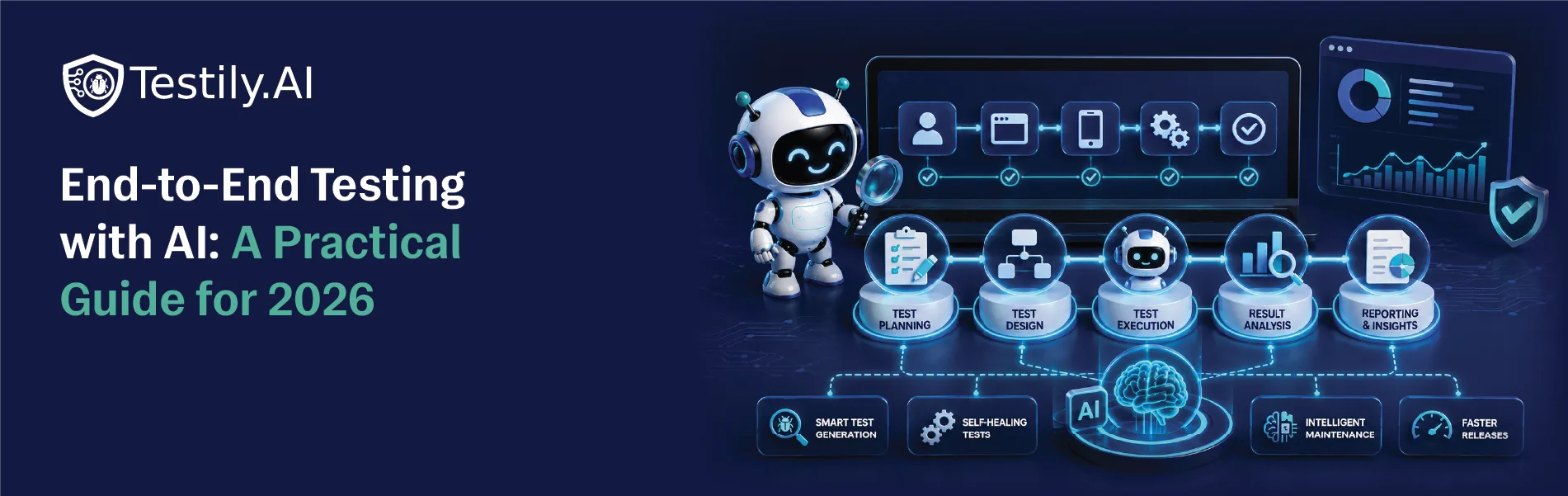
End-to-end testing always sounds better than it feels in real life. On paper, it’s simple. You run a full user flow, check everything from start to finish, and make sure nothing breaks. That’s the idea. But once you actually start doing it at scale, it becomes something else entirely. A small UI change breaks something random. A backend response shifts slightly. Some tests that used to run fine suddenly start failing “for no reason,” and you spend more time figuring out what broke the test than what broke the product. That’s usually when teams start looking at end-to-end testing with AI. Not because it’s trendy. More because they’re tired of fixing the same kind of failures again and again. This is usually when teams start exploring platforms like Testily.AI, which helps stabilize end-to-end tests and reduce repeated failures without constant manual fixes.
E2E testing isn’t the issue… it just doesn’t stay stable
Most teams don’t struggle to write end-to-end tests. That part is fine. The problem starts later when the product grows. Everything becomes connected in ways you don’t really notice at first. A locator that used to work suddenly doesn’t. A timing issue starts showing up only in CI. Test data behaves differently depending on the environment, and none of it feels serious individually. But together, it slowly turns into a maintenance problem. That’s what makes software testing automation feel heavier over time. Tools like Testily.AI helps reduce this maintenance overhead by adapting to small changes and keeping test flows stable as systems evolve.
So what actually changes with AI?
Honestly, not as much as people expect at first. You’re not replacing your framework. You’re not rebuilding your tests. The main change is simple tests don’t break as easily for small, stupid reasons. If something shifts slightly in the UI, the test doesn’t immediately fall apart, and when something does fail, it usually gives a bit more context instead of just “expected vs actual.” It sounds small, but in real QA work, that saves a lot of time. That’s where end-to-end testing with AI quietly starts making a difference. That’s where platforms like Testily.AI start making a practical difference by reducing unnecessary failures and improving test stability without adding extra maintenance work.
Where you actually feel it in day-to-day work
It’s not dramatic. It’s not like everything suddenly becomes perfect. It’s more like… fewer annoying interruptions.
Fewer random failures that don’t mean anything
You know those failures where nothing is actually broken?
A button moved a few pixels. A class name changed. Something cosmetic, and suddenly 5 tests are red. With end-to-end testing with AI, those things don’t always blow up the suite anymore. Some tests just adjust or don’t fail unnecessarily. So the pipeline feels calmer. Less noisy.
Debugging gets slightly less painful
E2E debugging is usually frustrating because you don’t know where to start. Was it timing? Was it data? Was it real?
You end up rerunning things just to understand the failure. AI doesn’t magically fix that, but it does help narrow things down a bit. Even that small improvement reduces a lot of everyday test automation challenges. Testily.AI supports this by identifying failure patterns and helping teams understand whether issues are real bugs or test instability.
Tests don’t go out of date as fast
This is something people underestimate. The product keeps changing, but tests don’t always keep up. After a while, you’re testing old behavior without realizing it. With end-to-end testing with AI, tests don’t drift as quickly because they adapt better when things change slightly.
Maintenance slowly stops eating your time
This is probably the biggest one. Instead of constantly fixing broken tests, you start spending more time actually looking at meaningful failures. Not everything disappears, obviously. But the constant firefighting reduces, and that’s where a good QA automation strategy actually starts feeling real instead of theoretical.
How teams usually start using it
Nobody flips a switch and changes everything. It usually starts with one painful area. A checkout flow that keeps breaking. A login test that fails randomly. A regression suite everyone avoids running on Friday. That’s where end-to-end testing with AI gets introduced first. Not everywhere. Just where things hurt the most. If it works there, teams slowly expand it.
The part nobody says out loud
AI doesn’t fix bad testing habits. If your test design is messy or your environments are unstable, you’ll still have problems. That doesn’t go away. What changes is how often you deal with the same issues. Instead of fixing the same flaky test every week, it shows up less frequently. That’s really the practical value of AI testing here.
Where Testily fits in
Testily.AI sits in that “reduce the pain” space. It’s not trying to replace QA teams or rewrite how testing works. It just helps with things like:
- Reducing flaky test failures
- Keeping E2E flows more stable
- Handling small changes without constant fixes
Basically, less time fixing tests, more time actually testing.
What Teams Eventually Figure Out
End-to-end testing was never the problem. It just doesn’t stay stable as systems grow, and that’s where most of the frustration comes from. Not writing tests… but maintaining them. With end-to-end testing with AI, things don’t become perfect. They just become less chaotic. Fewer false failures. Less guessing. Less time wasted on things that don’t really matter, and slowly, testing starts feeling manageable again instead of something that’s always behind. If your team is spending more time fixing E2E tests than trusting them, that’s usually the real signal.
Struggling with unstable end-to-end tests? Testily.AI helps you reduce flaky failures and keep your test suites reliable as your product evolves.