


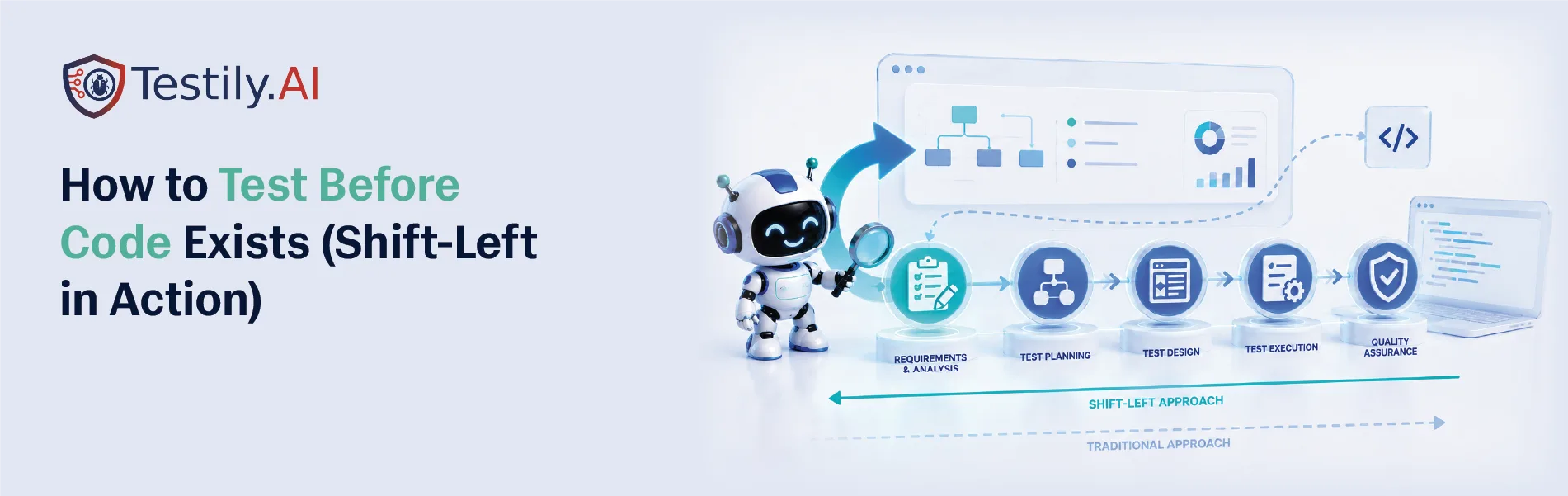
How to Test Before Code Exists: Shift-Left in Action
In most FinTech teams, testing doesn’t fail because QA is weak. It fails because it starts too late. By the time code is ready, you’re already under pressure. Deadlines are close. Compliance checks are pending. And if something critical breaks, it’s not just a bug, it’s risk. That’s where shift-left testing starts becoming less of a “best practice” and more of a necessity. This is often where teams start exploring platforms like Testily.AI, which help bring testing earlier into the workflow without adding extra overhead.
What testing looks like when you don’t shift left
This is a pretty common pattern. A new feature gets planned, say, a payment flow update. Developers build it. QA waits for the build. Testing starts late in the cycle. And then:
- Edge cases show up
- Logic gaps appear
- Flows don’t match real-world usage
Now everything becomes urgent. Fixes, retesting, and coordination are all happening at the worst possible time. This is exactly what shift-left testing is trying to avoid.
If this feels familiar, it’s usually not just about when testing starts. A lot of teams run into similar issues later when automation begins to behave unpredictably, especially when tests start failing without clear reasons. Tools like Testily.AI helps teams avoid this late-stage chaos by enabling earlier validation and reducing the pressure that builds up during final testing cycles.
What changes when testing starts before code exists
The first time a team tries this, it feels unusual. QA gets involved before development even begins. Not to “test” code but to understand what’s being built.
In FinTech, this usually means:
- Reviewing transaction logic
- Questioning edge cases
- Validating compliance scenarios
- Thinking through failure states
This is where shift-left testing actually starts inside discussions, not test environments.
But even after moving testing earlier, some teams still feel like releases slow down at the final stage. That’s usually where the problem shifts from timing to the overall workflow structure.
A real scenario most FinTech teams recognize
A team was working on a recurring payments feature. On paper, it looked simple. But during the requirement review, QA pointed out:
“What happens if the payment fails after partial processing?” That one question uncovered multiple gaps. Retries. Notifications. Data consistency. None of that was fully defined. That’s the impact of shift-left testing catching issues when fixing them is still easy.
What improves when teams adopt shift-left testing
It’s not dramatic. But it’s noticeable.
Fewer late surprises : Issues don’t pile up at the end. They get caught early in the software testing lifecycle.
Less pressure during release : When testing isn’t delayed, releases don’t feel rushed or risky.
Better collaboration : QA is no longer the “final step.” It becomes part of product thinking.
Higher confidence in production : Especially in FinTech, where mistakes are expensive, shift-left testing reduces uncertainty. Testily.AI supports this by helping teams maintain consistency between early-stage validation and later testing phases, reducing gaps across the software testing lifecycle.
Where tools start helping without overcomplicating it
Most teams already have:
- CI/CD testing pipelines
- QA automation setups
What’s changing is how early these are used. platforms like Testily.AI helps teams apply shift-left testing more effectively by aligning QA with early-stage workflows instead of waiting for execution. This allows teams to validate requirements, identify risks earlier, and reduce the accumulation of late-stage issues.
What teams eventually figure out
Testing earlier doesn’t mean doing more work. It just means doing the right work sooner. In FinTech, that difference matters more than most industries. Because by the time code exists, the cost of mistakes is already too high.
If you’re already involving QA earlier in discussions, the next step usually isn’t adding more tests; it’s figuring out how to keep everything manageable as systems grow. That’s where scaling QA and maintaining stability start becoming the bigger challenges.
Trying to catch issues earlier in your release cycle? Testily.AI helps FinTech teams apply shift-left testing without increasing complexity or slowing down delivery.