
Case Study: Cutting Test Maintenance by 75%

Case Study: Cutting Test Maintenance by 75% At one point, the team wasn’t struggling with testing. They were struggling with maintaining tests. Every sprint looked the same: Tests failed. Scripts were fixed. Pipelines rerun, and then it happened again. That’s when they realized the problem wasn’t testing. It was maintenance. The situation The team was growing fast. More features. More releases. More automation. But over time: Nearly 40% of QA effort went into fixing tests UI changes caused frequent failures Pipelines required constant reruns Confidence in automation started dropping They weren’t scaling testing. They were scaling maintenance. The turning point Instead of adding more tests, they asked a different question: “Why are we fixing the same things repeatedly?” That’s when they explored AI-driven testing, not to replace automation, but to stabilize it. What they changed They didn’t rebuild everything. They focused on high-maintenance areas first: UI-heavy test suites Frequently failing regression tests Flaky test patterns Then they introduced the following: Self-healing capabilities Smarter failure analysis Adaptive test behavior (using Testily.AI to support this shift) How Testily.AI made the difference Instead of just running tests, Testily helped the team: Automatically adjust tests when UI or flows changed Detect and reduce flaky failures across pipelines Provide clearer insights into why tests failed Minimize the need for constant script updates So instead of reacting to failures, the system started handling a large part of the maintenance itself. What improved Within a few cycles, changes became visible: 1. Test maintenance dropped by 75% Fewer broken scripts. Less manual fixing. 2. Flaky tests reduced significantly Failures became more reliable and meaningful. 3. Pipeline stability improved Fewer reruns. Faster releases. 4. QA focus shifted From fixing tests → to improving product quality. What didn’t change This wasn’t magic. They still Reviewed test results Validated scenarios Stayed involved in QA decisions The difference? They stopped solving the same problems repeatedly. What other teams can learn from this Most teams don’t realize how much time goes into maintenance until they reduce it, and when they do, Testing feels lighter Releases feel smoother QA becomes proactive instead of reactive That’s the real impact of cutting test maintenance by 75%. Conversion-focused close If your team is stuck in a loop of fixing broken tests, it’s not a sign that automation isn’t working. It’s a sign that it needs to evolve. If you want to see how teams are reducing maintenance without rebuilding everything, it’s worth exploring how Testily.AI fits into your workflow. → See how much time your team spends fixing tests today → Or explore how AI-driven testing can stabilize your automation FAQs 1. Is 75% reduction realistic? Yes, especially in high-maintenance environments. 2. What role did Testily.AI play? It reduced repetitive fixes by adapting tests and improving stability. 3. Did the team replace their framework? No. They improved how it handled change. 4. How fast were results visible? Within a few sprints. 5. What’s the biggest takeaway? Reducing maintenance creates more impact than adding more tests.
How AI Testing Can Reduce Test Maintenance by 70% and Why Teams Are Paying Attention
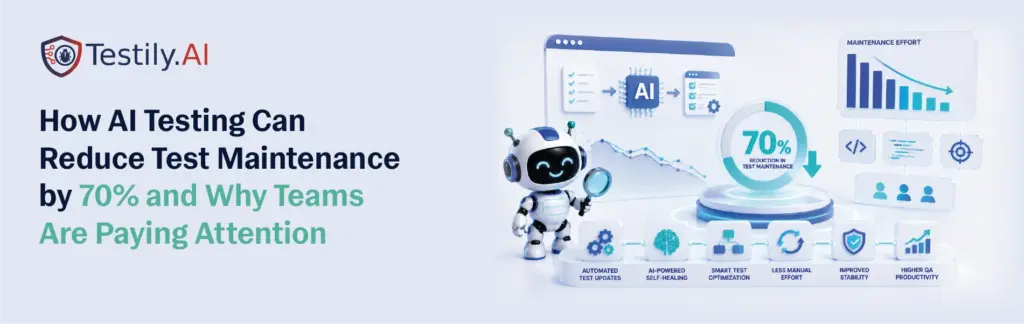
At some point, maintaining tests becomes the real work Most teams don’t feel the pain at the beginning. Automation feels like progress. Tests run. Pipelines look stable. Everything seems under control. But slowly, things change. A few tests fail. You fix them. Then more breaks, and without realizing it, your effort shifts from building coverage… to maintaining it. That’s usually when teams start seriously exploring AI testing not as a trend but as a way to reduce test maintenance by 70% and escape constant firefighting. The real issue isn’t automation; it’s what comes after Automation works. It runs tests. It improves coverage. But it also creates something teams don’t fully plan for: maintenance overhead. Every small change leads to: Broken locators Unstable runs Repeated debugging And this becomes routine. This is where AI starts making a practical difference by reducing the ongoing effort that automation creates. What actually changes with AI testing AI doesn’t replace your framework. It changes how much effort it needs. Tests become less fragile. Failures become clearer. Fixes take less time. That’s where teams begin to see how AI testing can reduce test maintenance by 70% in real workflows, not just in theory. Where teams feel the impact first 1. UI changes stop breaking everything Small UI updates no longer cascade into failures. Tests adapt. This is often the first sign that AI is working. 2. Failures become meaningful Instead of guessing: Is it flaky? Is it real? AI testing helps identify patterns. Which means less time debugging and more time fixing real issues. 3. Test suites stay aligned with the product Normally, tests lag behind product changes. With AI , they evolve alongside it. That alone significantly reduces maintenance effort. 4. Flaky tests stop dominating your time Flaky tests are one of the biggest hidden costs. They: Fail randomly Pass on reruns Kill trust AI testing reduces this instability by learning from patterns. This is where teams most clearly experience up to a 70% reduction in maintenance effort. What “70% reduction” actually means Let’s keep it real. It doesn’t mean Zero maintenance Zero debugging Fully autonomous QA It means: Fewer repetitive fixes Less debugging time More stable runs Reduced daily firefighting In simple terms: You stop solving the same problem repeatedly. How teams adopt AI testing (without disruption) No big overhaul. Most teams start small: Flaky test suites Regression packs High-maintenance flows Then introduce: Self-healing tests Failure pattern detection Intelligent updates That’s how AI testing scales gradually and safely. A quick reality check AI testing is powerful but not magic. If: Test design is weak Requirements are unclear Processes are messy Then AI will only optimize inefficiency. The best results come when AI supports a solid QA foundation. Why teams are paying attention now Earlier, maintenance was tolerated. Now it’s a problem. Because: Releases are faster CI/CD is constant QA cycles are shorter In this environment, AI isn’t optional anymore; it’s practical. Where Testily.AI fits in This is exactly what platforms like Testily.AI focuses on. Instead of replacing your system, it helps: Reduce repetitive maintenance Stabilize automation Keep tests aligned with changes So your team can focus on quality not upkeep. Why this shift matters Automation was supposed to reduce effort. But for many teams, it just shifted effort to maintenance. With AI testing, that balance starts correcting itself. Less fixing. More building. Better releases. FAQs 1. What is AI testing? AI testing uses machine learning to improve test stability, reduce maintenance, and adapt to changes automatically. 2. Can AI testing really reduce maintenance by 70%? Yes, especially in high-maintenance environments with flaky tests and frequent UI changes. 3. Does AI testing replace QA teams? No. It removes repetitive work so teams can focus on higher-value tasks. 4. How does AI testing handle flaky tests? It identifies patterns and reduces instability across runs. 5. Is it difficult to implement? No. Most teams start with a small, high-impact area.
How to Reduce Test Maintenance Effort by 50%

Why Your Team Spends More Time Fixing Tests Than Writing Them A QA lead said something to me recently that stuck. “We’re not struggling to create tests. We’re struggling to keep them working.” At first, it sounds like a small observation. But the more you think about it, the more it explains what’s actually going wrong in many teams. Because when automation starts, the focus is clear. Write tests. Increase coverage. Move faster. Show progress, and in the beginning, that works. You see numbers go up. Dashboards look healthy. It feels like momentum. But after a while, something shifts. The tests are already there. Coverage looks “good enough.” And suddenly, the problem isn’t about writing tests anymore. It’s about keeping them alive, and that’s where things start slowing down. This is often the point where teams start exploring platforms like Testily.AI, which are designed to reduce the effort required to keep tests stable as products evolve. The Work Nobody Plans For When teams think about automation, they mostly think about the setup phase: writing scripts, building frameworks, and getting tests into CI. What doesn’t get enough attention is what happens a few months later. The product evolves. The UI changes. Flows get tweaked. Each change feels minor. But together, they start affecting the test suite, and slowly, the nature of work changes. Instead of building new coverage, teams spend time on things like: Fixing selectors that no longer match Updating flows that have slightly changed Re-running failed tests just to confirm behavior Figuring out whether failures are real or just noise Cleaning up tests that worked perfectly last sprint None of this feels like meaningful progress. But it becomes a big part of the day. Where the Time Actually Goes If you watch a QA team closely for a few days, the pattern becomes hard to miss. A test fails. Someone checks it. Is it a real issue? Or did something change in the UI? They fix a selector. Run it again. Now something else fails, and the cycle continues. Each interruption is small. A few minutes here, maybe half an hour there. But together, they eat into a large portion of the team’s time. In many teams, a significant chunk, sometimes close to 50%, goes into the following: Keeping existing tests running Fixing breakages caused by product changes Validating whether failures actually matter Maintaining confidence in the test suite Not improving quality. Not finding new bugs. Just… keeping things from breaking. Tools like Testily.AI help reduce this overhead by minimizing manual fixes and making test suites more resilient to frequent product changes. Why Tests Break So Easily Most test suites are more fragile than they look. Not because they’re poorly written, but because they depend on things that change all the time. UI elements shift. Labels get updated. Layouts move. Steps in a flow are adjusted. From a product perspective, these are normal improvements. But from a test’s perspective, they can look like failures. The feature still works. The user experience is fine. But the test was built for yesterday’s version, and today is slightly different. So the cycle continues: Product changes Tests fail Someone fixes them The next change breaks something else Over time, this stops being occasional work and becomes part of every release. The Hidden Cost: Uncertainty Broken tests are frustrating, but the bigger issue is what they create: doubt. When a test fails, the real question becomes the following: “Is this a bug… or is the test wrong?” That uncertainty slows everything down. Now you’re not just testing the product; you’re questioning the test itself, and when false failures happen too often, trust starts to drop. You’ll see it in subtle ways: Failures don’t feel urgent anymore People assume it’s “probably just a test issue.” More time is spent double-checking results At that point, your test suite isn’t helping speed things up. It’s adding friction. Why Adding More People Doesn’t Fix It The instinctive reaction is to add more people. More QA engineers. More ownership. More processes, and yes, that can help for a while. But if the system itself needs constant fixing, adding people doesn’t solve the problem; it just spreads it out. You still have: Fragile tests Frequent failures Time spent separating real issues from noise The workload stays the same. Only the distribution changes. What Actually Reduces Test Maintenance Effort Teams that successfully reduce maintenance don’t just focus on writing more tests. They focus on making tests easier to maintain. That shift makes a huge difference. You’ll usually see patterns like the following: Reducing dependency on fragile UI elements Avoiding overly complex or bloated test suites Prioritizing stability over sheer coverage numbers Focusing on clean, reliable signals from tests Minimizing manual fixes and repeated intervention One important realization is this: More tests don’t automatically mean better testing. A smaller, stable suite often delivers far more value than a large, fragile one. Platforms like Testily.AI support this approach by using AI to adapt to UI and workflow changes, reducing the need for constant manual updates. What Changes When Maintenance Drops When maintenance effort goes down, the impact is immediate. Tests stop failing for avoidable reasons. Teams spend less time debugging scripts. QA cycles become more predictable. Releases feel smoother. Less rushed. Less uncertain. It’s not a dramatic shift; it’s just less friction, and that makes everything easier. QA becomes something teams rely on again, instead of something they second-guess. The Part Teams Underestimate Maintenance rarely shows up as one big, obvious problem. It shows up in small moments: A quick fix before release A rerun because something felt off A double-check because no one fully trusts the result Each one feels minor. But over time, they add up to a significant drain, and because it happens gradually, teams often don’t realize how much time they’re losing. A Better Way to Approach Test Maintenance If your team feels stuck fixing tests more than benefiting from them, it’s usually a sign the system itself