


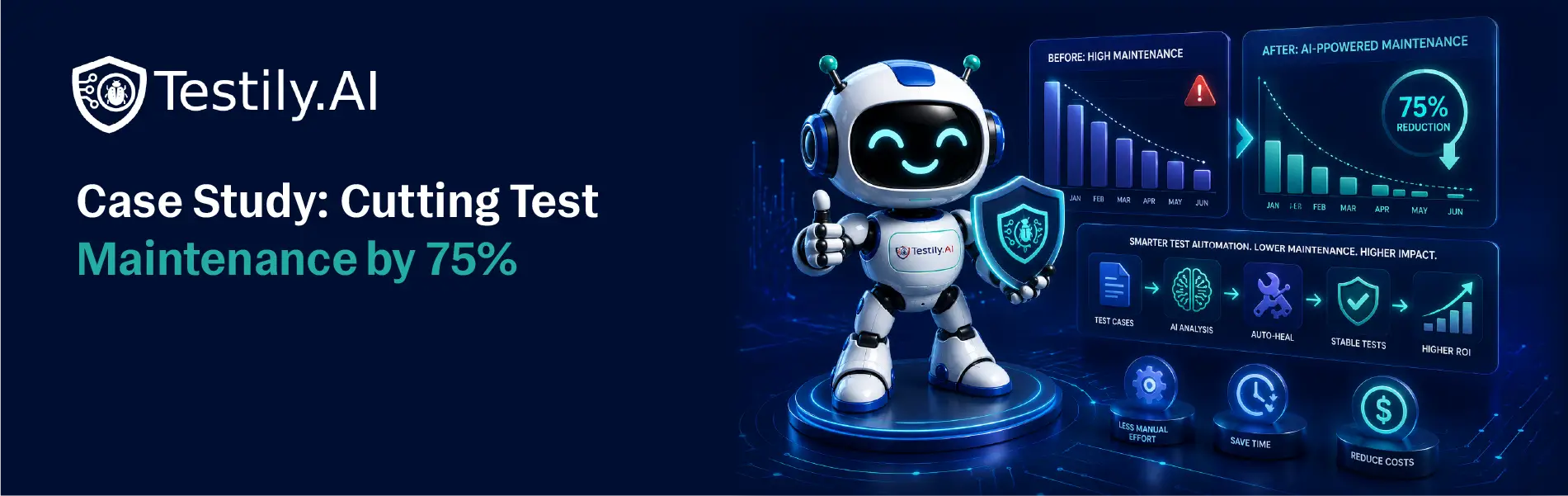
Case Study: Cutting Test Maintenance by 75%
At one point, the team wasn’t struggling with testing. They were struggling with maintaining tests. Every sprint looked the same: Tests failed. Scripts were fixed. Pipelines rerun, and then it happened again. That’s when they realized the problem wasn’t testing. It was maintenance.
The situation
The team was growing fast. More features. More releases. More automation. But over time:
- Nearly 40% of QA effort went into fixing tests
- UI changes caused frequent failures
- Pipelines required constant reruns
- Confidence in automation started dropping
They weren’t scaling testing. They were scaling maintenance.
The turning point
Instead of adding more tests, they asked a different question: “Why are we fixing the same things repeatedly?” That’s when they explored AI-driven testing, not to replace automation, but to stabilize it.
What they changed
They didn’t rebuild everything. They focused on high-maintenance areas first:
- UI-heavy test suites
- Frequently failing regression tests
- Flaky test patterns
Then they introduced the following:
- Self-healing capabilities
- Smarter failure analysis
- Adaptive test behavior
(using Testily.AI to support this shift)
How Testily.AI made the difference
Instead of just running tests, Testily helped the team:
- Automatically adjust tests when UI or flows changed
- Detect and reduce flaky failures across pipelines
- Provide clearer insights into why tests failed
- Minimize the need for constant script updates
So instead of reacting to failures, the system started handling a large part of the maintenance itself.
What improved
Within a few cycles, changes became visible:
1. Test maintenance dropped by 75%
Fewer broken scripts. Less manual fixing.
2. Flaky tests reduced significantly
Failures became more reliable and meaningful.
3. Pipeline stability improved
Fewer reruns. Faster releases.
4. QA focus shifted
From fixing tests → to improving product quality.
What didn’t change
This wasn’t magic. They still
- Reviewed test results
- Validated scenarios
- Stayed involved in QA decisions
The difference? They stopped solving the same problems repeatedly.
What other teams can learn from this
Most teams don’t realize how much time goes into maintenance
until they reduce it, and when they do,
- Testing feels lighter
- Releases feel smoother
- QA becomes proactive instead of reactive
That’s the real impact of cutting test maintenance by 75%.
Conversion-focused close
If your team is stuck in a loop of fixing broken tests, it’s not a sign that automation isn’t working. It’s a sign that it needs to evolve. If you want to see how teams are reducing maintenance without rebuilding everything, it’s worth exploring how Testily.AI fits into your workflow.