Testily.AI

The Hidden Cost of Flaky Tests in CI/CD
Why Your Test Automation Keeps Breaking (And How to Fix It)

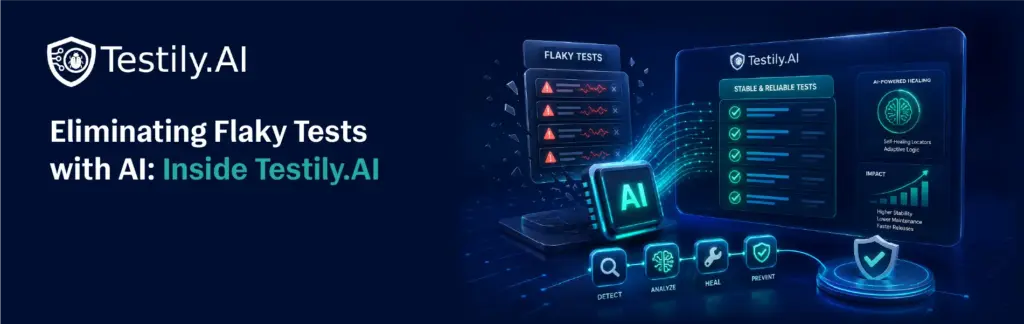
Not every failed test actually means something is broken If you’ve worked with CI/CD pipelines for even a short time, you’ve probably seen this. A test fails. Nothing in the code changed. You rerun it… and it passes. At first, it doesn’t feel like a big deal. Just rerun and move on. But over time, this starts happening more often. And that’s when things quietly begin to slow down. Not in an obvious way. Just enough that your CI/CD flow starts feeling… unreliable. What flaky tests actually look like in CI/CD Flaky tests are simple to describe, but frustrating to deal with. They pass sometimes. Fail sometimes, and don’t give you a clear reason why. In a CI/CD setup, where everything depends on fast and reliable feedback, that inconsistency becomes a real problem. Because now, every failure raises a question: “Is this real… or do I rerun it?” The hidden cost most teams don’t notice Flaky tests don’t break things instantly. They create friction slowly. 1. CI/CD pipelines start slowing down One rerun doesn’t matter. But multiple reruns across builds? That adds up quickly. Your CI/CD pipeline starts taking longer, not because of complexity but because of uncertainty. 2. People stop trusting the pipeline This is where it gets serious. If failures aren’t reliable, developers stop reacting to them. They rerun first. Investigate later, and once that habit forms, your CI/CD system stops being a source of truth. 3. Debugging becomes a time sink You end up spending time chasing issues that don’t exist. Was it: a real bug? a timing issue? an environment glitch? That confusion is one of the biggest hidden costs in CI/CD workflows. 4. Decision-making slows down Releases get delayed not because something is broken, but because no one is completely sure if everything is working, and in a fast-moving CI/CD environment, that hesitation compounds quickly. Why flaky tests show up in CI/CD systems Most teams don’t “create” flaky tests intentionally. They creep in because of things like: unstable environments timing dependencies shared test data UI-heavy automation And as your CI/CD system scales, these small issues become more frequent. How teams usually try to fix this and where it goes wrong Most teams respond in one of two ways: Ignore flaky tests → pipeline becomes noisy Add retries → problem gets hidden Neither really solves the issue. Because flaky tests in CI/CD are not just test problems; they’re system problems. What actually works when fixing CI/CD instability The fixes are usually less about tools… and more about discipline. Stabilize environments so behavior is predictable Remove hard-coded waits and timing hacks Keep tests independent (no shared state) Track flaky patterns instead of ignoring them But here’s the catch: Doing all of this manually… doesn’t scale well in a growing CI/CD system. Where AI starts making a real difference This is where things start to shift. Instead of reacting to flaky tests, teams start identifying patterns earlier. Modern AI-driven approaches can: detect inconsistent test behavior across runs flag unstable tests before they spread highlight probable root causes reduce unnecessary reruns in CI/CD And that’s where tools like Testily.AI start fitting in naturally. Not as a replacement for QA, but as a way to remove the noise that slows everything down. Why Testily.AI fits this problem so well Most tools help you run tests. But flaky tests in CI/CD aren’t about running tests; they’re about understanding why they behave inconsistently. That’s where Testily.AI stands out. It helps teams: automatically identify flaky patterns across runs reduce noise in test results (so failures actually mean something) adapt to UI and environment changes without constant rewrites keep CI/CD pipelines stable without adding manual effort Instead of chasing failures, teams start trusting their pipeline again. Flaky tests aren’t noise they’re a warning sign It’s easy to ignore flaky tests. But they usually indicate something deeper: instability in your test design gaps in your environment or scaling issues in your CI/CD system Fixing them isn’t just cleanup. It’s what keeps your pipeline reliable as your product grows. When CI/CD starts feeling stable again Once flaky behavior is reduced, something interesting happens. pipelines run without constant interruptions failures become clearer teams stop rerunning builds “just to be sure.” And suddenly, your CI/CD process feels predictable again. Not perfect. Just… dependable. If this feels familiar, it’s probably already costing you Most teams don’t track how much time flaky tests waste. But if your team is: rerunning pipelines often questioning test results spending time debugging non-issues Then your CI/CD system is already carrying a hidden cost. You don’t need more tests. You need more stable ones, and that’s exactly where a shift toward smarter, AI-supported testing starts making sense. FAQs 1. What are flaky tests in CI/CD? Flaky tests in CI/CD are tests that pass or fail inconsistently without any code changes. 2. Why do flaky tests happen? They usually occur due to unstable environments, timing issues, or shared dependencies. 3. How do flaky tests affect CI/CD pipelines? They slow down pipelines, reduce trust in results, and create uncertainty in release decisions. 4. Can flaky tests be completely eliminated? Not entirely, but they can be significantly reduced with better test design and smarter detection. 5. How does AI help in CI/CD testing? AI helps detect instability patterns, identify flaky tests early, and reduce maintenance effort. 6. How does Testily.AI help with flaky tests? It identifies flaky behavior automatically, reduces noise in results, and improves CI/CD reliability without constant manual fixes.