

Functional vs. Non-Functional Testing: A Practical Breakdown
Okay, real talk for a second. Someone on your team files a bug. Someone else asks, “Is that functional or non-functional?” And there’s this half-second pause where everyone in the meeting quietly hopes someone else answers first.
I’ve watched this happen more times than I’d like to admit. It’s not that functional vs non-functional testing is some deep mystery; it’s more that nobody ever sits down and actually explains it in plain English. Everyone just kind of absorbs the terms over time and hopes for the best. So let’s fix that here. No jargon dump, promise.
The Short Version, If You’re In a Hurry
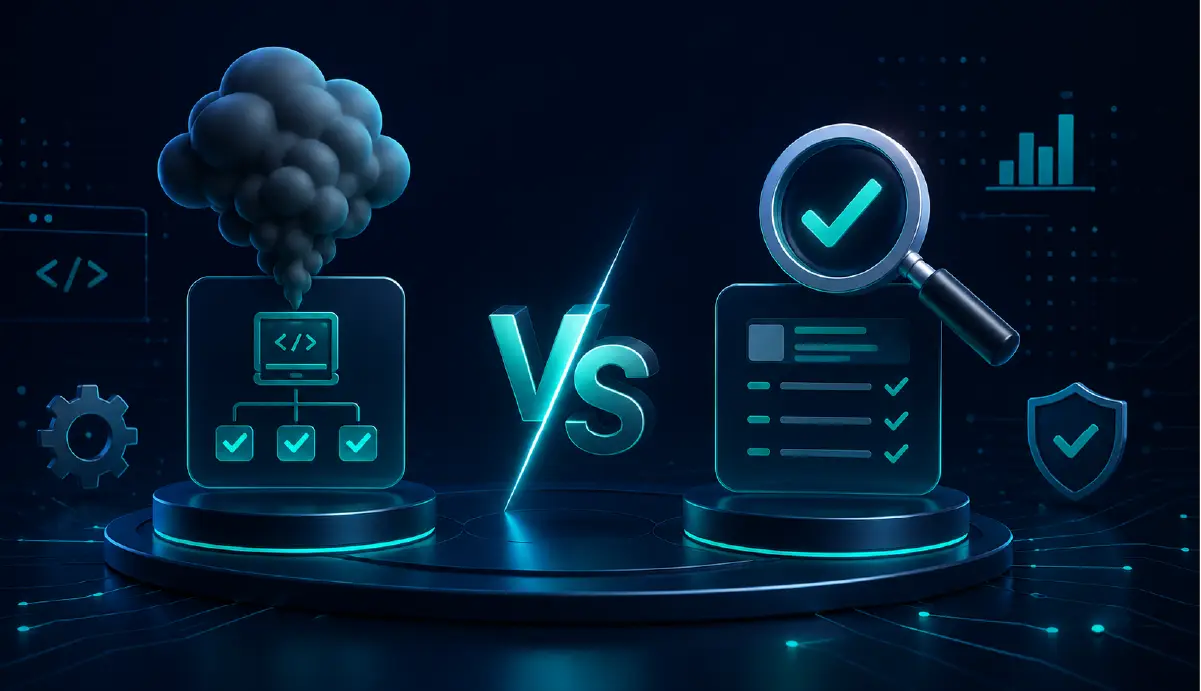
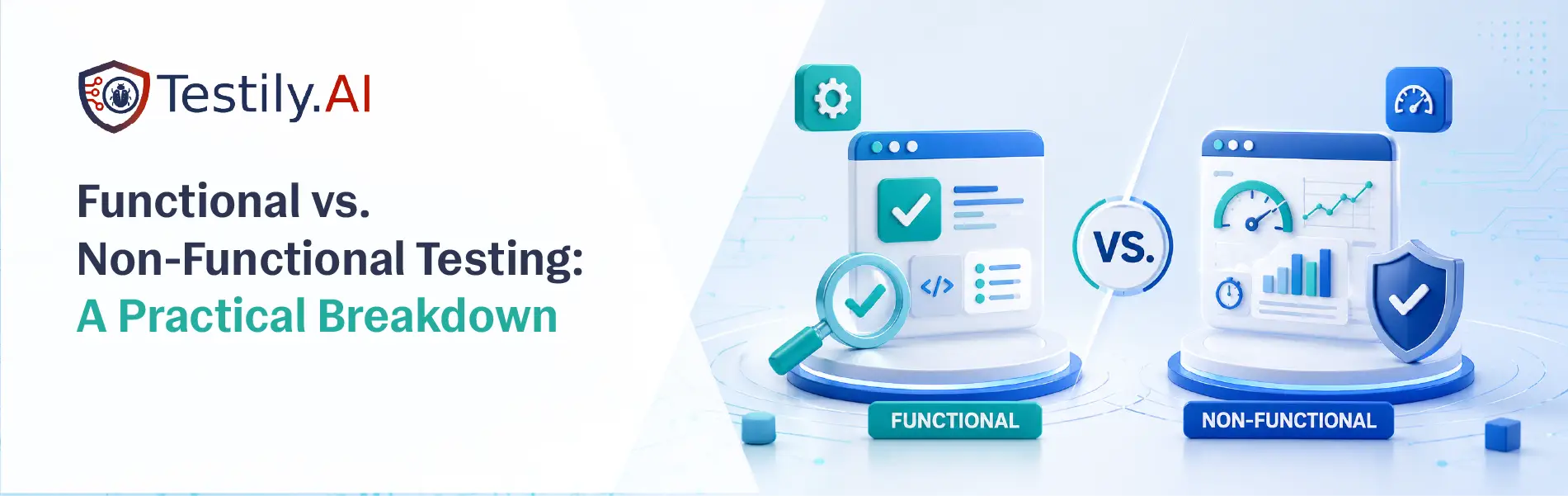
Functional testing is about what the software does. Non-functional testing is about how well it does it. That’s genuinely most of the concept right there when it comes to functional vs non-functional testing. Everything else is just detail stacked on top. And for what it’s worth, Testily.AI builds coverage for both sides straight out of your requirements, so you’re not stuck picking one and crossing your fingers on the other.
Functional Testing, The Part Everyone Already Knows
Functional testing checks that a feature behaves the way the spec said it would. The spec says “clicking Submit saves the form and shows a confirmation”; functional testing checks exactly that, nothing fancier. Did it save? Did the message pop up? Did the data end up where it should’ve?
This is the testing most people picture the second you say “QA.” A few of the usual suspects:
- Unit testing. Individual functions, checked on their own.
- Integration testing. Making sure separate pieces actually work together instead of just existing near each other.
- Regression testing. Confirming a new change didn’t quietly wreck something old.
- User acceptance testing (UAT). Checking the software actually solves the business problem, from a real user’s seat.
At the end of the day, functional testing is answering one binary question, does this work, yes or no. Testily.AI takes your BRDs and user stories and turns each requirement into an actual traceable test case automatically. Which means that a yes-or-no question always has something backing it up, instead of relying on someone remembering to write a test at 5pm on a Friday.
Non-Functional Testing, The Part Everyone Forgets
Non-functional testing pulls back from “Does it work?” and asks something blurrier: Does it work well? Less about one feature doing its job, more about the whole experience: Is it fast? Is it stable? Is it safe? Does it actually feel good to use?
Under this umbrella you’ll usually find the following:
- Performance testing — can it handle expected traffic without choking
- Load and stress testing — what happens once traffic goes way past “expected”
- Security testing — is data protected, do the obvious attacks get blocked
- Usability testing — can an actual human get through it without wanting to throw their laptop
- Compatibility testing — same behavior across browsers and devices, or not
None of that has anything to do with whether a button fires the right function. It’s whether the whole system survives contact with real people and real traffic. And honestly? This is the category almost every team shortchanges, mostly because setting it up properly is a genuine hassle. That gap is basically the reason Testily.AI exists in this part of the conversation — it generates non-functional scenarios right alongside the functional ones, so performance and security testing stop being the thing everyone means to get to “later.”
Side by Side, Quickly
| Aspect | Functional Testing | Non-Functional Testing |
|---|---|---|
| Core question | Does it do what it should? | Does it do it well? |
| Focus | Features, business logic | Performance, security, usability |
| Based on | Functional requirements | Quality attributes |
| Example | Login works with valid credentials | Login page loads under 2 seconds at peak load |
| Typical timing | Throughout development | Often later, though it really shouldn’t be |
| Common tools | Selenium, Cypress, Playwright | JMeter, LoadRunner, OWASP ZAP |
For what it’s worth, this lines up pretty closely with how ISO/IEC 25010 formally splits up software quality. Functional suitability gets its own category, and performance, security, usability, and the rest all sit under the broader non-functional umbrella. Once you see functional vs non-functional testing laid out this way, it stops feeling academic. One side’s about correctness. The other’s about whether the thing actually survives the real world.
Why Teams Keep Favoring One Side (Spoiler: It’s Functional)
Here’s something I’ve noticed after sitting through a lot of these release cycles: most teams are pretty good at functional testing and genuinely shaky on non-functional, especially in the early days of a product. Makes sense, actually. A broken checkout button gets noticed in seconds. A page that’s two seconds slower than it should be? Nobody writes that up. It just sits there, quietly annoying people, until churn starts looking weird a few months later and nobody can explain exactly why.
By the time anyone traces it back, the non-functional problems are usually baked into the architecture, and fixing them costs way more than it would’ve early on. That’s the whole case for treating functional and non-functional testing as equally serious from day one, not something you’ll circle back to once things “calm down.” Things rarely calm down on schedule. You know this already.
A Quick Example, Because Theory Only Gets You So Far
Take an e-commerce checkout flow.
Functional testing makes sure the cart totals up correctly, discount codes apply, payment goes through, and the confirmation email actually sends.
Non-functional testing makes sure that the same checkout stays responsive when 5,000 people hit it during a flash sale; that payment data is encrypted the way it should be; that the page still loads fast on a mid-range phone with shaky wifi; and that Safari doesn’t suddenly behave differently than Chrome for no reason.
Ship something that only clears the functional checks, and it might look perfect in a demo. Then real traffic shows up and it falls over. That’s functional vs non-functional testing in one very real, very expensive example.
Why Non-Functional Testing Is Genuinely Harder to Pull Off
Non-functional testing needs infrastructure, a lot of teams just don’t have sitting around; load generation; realistic traffic simulation; and proper security scanning setups. This is usually where functional vs non-functional testing splits apart in practice: functional testing’s comparatively simple to script and automate. That’s a big part of why it gets more attention by default. Not because anyone decided it mattered more. It’s just easier.
This is one of the specific gaps Testily.AI was built to close. Because it generates coverage directly from requirements instead of reverse-engineering tests after the fact, it’s a lot easier to bake performance and edge-case scenarios into the same pipeline as the functional checks, instead of treating non-functional testing like a side project that only gets budget the week before launch.
Bringing It All Back Together
Functional vs non-functional testing was never really a hierarchy. Neither side outranks the other; they’re just answering different questions. A feature that technically works but collapses under real load isn’t actually done. And a system that’s fast and secure but does the wrong thing isn’t especially useful either.
If you want a deeper look at where this tends to break down in complex, API-driven products, Testily.AI‘s SaaS testing page walks through a few patterns worth knowing.
Ready to Cover Both Without Doubling Your Workload?
Testily.AI builds functional and non-functional test cases from the same requirements, keeps them traceable as specs shift, and runs them automatically. Performance and security testing stop being the thing your team meant to get to eventually.
Schedule a demo with Testily.AI and see both types of coverage built from a single set of requirements.