

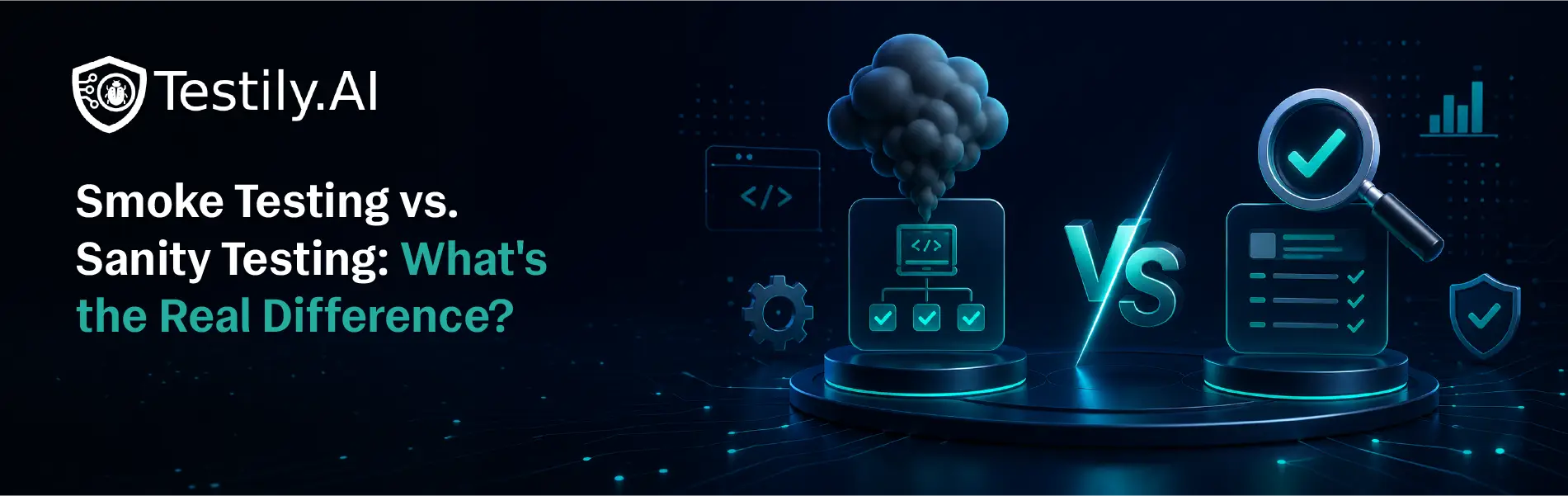
Smoke Testing vs. Sanity Testing: What’s the Real Difference?
I’ve sat in more release standups than I can count where someone says, “We ran a smoke test,” and someone else immediately goes, “Wait, don’t you mean sanity test?” And then the whole room just kind of shrugs. Nobody’s really sure. Everyone nods along anyway.
That’s the thing about smoke testing vs sanity testing; the two get used interchangeably so often that most testers, even experienced ones, have to stop and think for a second before explaining the actual difference. Which is a little wild, because once you see it clearly, it’s not complicated at all. The difference between smoke and sanity testing really just comes down to timing and scope, not some deep conceptual gap.
Testily.AI actually runs into this confusion a lot when we talk to QA teams, which is part of why the platform tags every generated test case by type from the start. Nobody on the team has to pause mid-sprint and debate which bucket a check belongs in.
Okay, So What Are We Actually Comparing?
Before jumping into smoke testing vs sanity testing side by side, it’s worth backing up. Both are “quick check” categories, fast, early, and not meant to replace full regression testing. But they’re answering two completely different questions, and that’s really the whole crux of it.
Smoke Testing, In Plain Terms
Smoke testing is the very first thing you run against a fresh build. The name, if you didn’t know, comes from old hardware testing: plug something in, flip the power on, and see if smoke comes out. If it does, you’re done. No point testing anything else until that’s sorted.
Software borrowed the metaphor pretty literally. You take a new build and hit the handful of paths that matter most: does the app even open? Can someone log in? Does the homepage render? Can a basic purchase go through? Miss any of those, and the build gets bounced immediately; there’s no reason to dig into smaller features on top of a broken foundation. According to the ISTQB Glossary, smoke testing is meant to determine whether a system works well enough before more detailed testing even begins, which is a pretty tidy way of putting it.
This is also exactly the kind of check Testily.AI can fire off the second a new build lands; no one has to remember to kick it off manually; it just runs.
Smoke testing, in short, is wide but shallow. It touches a lot, but only on the surface.
Sanity Testing, In Plain Terms
Sanity testing comes later, usually right after a smoke test has already passed and someone’s fixed a specific bug or made a small, targeted change. Instead of poking at the whole app again, you zoom in on exactly what changed and confirm the fix actually did what it was supposed to, without knocking anything nearby out of place.
Here’s a real example. Say a dev patches a bug where discount codes weren’t applying at checkout. A sanity check would specifically confirm the discount code now works and maybe glance at the cart total updating correctly right after. You wouldn’t waste time re-checking the login screen or the search bar; nothing there was touched. Testily.AI handles this by tracing the fix back to whichever requirement it belongs to and only re-running the tests tied to that exact area, so there’s no manual guessing about what counts as “closely related.”
Sanity testing, unlike smoke testing, is narrow but deep. If you’re still fuzzy on it, that contrast, wide-and-shallow versus narrow-and-deep, is really the whole difference between smoke and sanity testing in a nutshell.
Side-by-Side, Because Tables Help
| Aspect | Smoke Testing | Sanity Testing |
|---|---|---|
| When it’s done | Right after a new build is deployed | After a specific bug fix or small change |
| Scope | Broad, covers major features | Narrow, focused on the changed area |
| Depth | Shallow | Fairly deep, within a limited scope |
| Goal | Confirm the build’s stable enough to test further | Confirm the fix works and nothing nearby broke |
| Who runs it | QA team, often automated in CI/CD | QA team, frequently manual or via targeted scripts |
| How formal | Usually scripted, repeatable | Often more exploratory |
Look at that table, and it’s easy to see why the two get mixed up. Both happen fast. Both happen before full regression. Both exist purely to save time. Honestly, the difference in smoke testing vs sanity testing comes down almost entirely to when you run it and how much ground it covers, not why you’re running it in the first place.
A Shortcut I Give Newer Testers
Smoke testing asks, “Is this build even worth my time?” Sanity testing asks, “Did that one specific fix actually work?”
Smoke testing happens once per build, early, wide, and shallow. Sanity testing can happen several times across the same build cycle, basically every time a new patch shows up needing a quick check. This is where a lot of hours quietly disappear on manual QA teams. Running a sanity pass takes a machine seconds. It takes a human tester a meaningful chunk of their afternoon, and that repeats all week if patches keep coming in.
Why Any of This Actually Matters
You might be wondering, does it really matter what we call it as long as testing’s happening? Fair question. But getting smoke testing vs sanity testing right changes how a team plans out its releases, not just what vocabulary gets used in Slack.
Skip smoke testing and jump straight into deep feature testing on a build that’s already broken, and your team burns hours chasing bugs that don’t even matter yet; the foundation’s cracked. On the flip side, treat every single bug fix as an excuse to run a full sanity sweep across unrelated modules, and you’re bleeding time on releases that should’ve shipped hours earlier.
Where Teams Usually Trip Up
A few patterns show up again and again, almost regardless of team size:
- Calling something a “smoke test” when it’s really just checking one feature, that’s a sanity test wearing a different name.
- Skipping smoke testing entirely because “the last build was fine,” then discovering a critical break three hours into detailed feature testing.
- Assuming a tiny fix couldn’t possibly need a sanity check. Small changes ripple outward more often than people expect.
- Doing both by hand, every single time, when a huge chunk of it could just run itself.
That last one is where a lot of QA leads start rethinking their whole approach. Manually re-running smoke checks on every build and manually verifying every patch with a sanity pass add up fast, easily hours a week, sometimes more depending on release cadence. Testily.AI generates and runs both types straight from your requirements, which means the team isn’t repeating the same clicks build after build after build.
Bringing It Together
Smoke testing vs sanity testing isn’t really a rivalry; they’re two checkpoints in the same pipeline, sitting at different moments. Smoke testing decides whether a build even deserves attention. Sanity testing confirms a specific fix did its job. Testily.AI runs both automatically, in the right order, every time the codebase changes, so nobody has to remember to trigger either one.
Use both, use them at the right time, and don’t let the overlapping vocabulary trick you into thinking smoke testing vs sanity testing is a distinction without a difference. Once a team gets this straight, release cycles get noticeably calmer, there are fewer wasted hours, and there are fewer “Didn’t we already check this?” moments in standup.
For teams building out a broader QA process, it’s worth checking Testily.AI‘s blog for more breakdowns like this one.
Ready to Stop Doing This by Hand?
If your team’s still manually deciding when to smoke test, when to sanity check, and how deep each one should go, that’s a lot of judgment calls Testily.AI can take off your plate. It generates both types of tests straight from your requirements, runs them automatically on every build and every patch, and keeps everything traceable so nothing slips through.
Schedule a free demo with Testily.AI and see what a release cycle looks like without the manual back-and-forth.