

Measuring ROI of AI in QA Teams
Most teams don’t start exploring AI testing because they want to follow a trend. They start because QA slowly becomes harder to manage. At first, the pressure is subtle. Releases take slightly longer. Pipelines need more reruns. Automation starts requiring constant maintenance. QA engineers spend more time fixing tests than validating quality. Nothing looks completely broken, but the overall effort keeps increasing. That’s usually the point where teams begin seriously measuring the ROI of AI in QA teams. Because eventually, every growing engineering team starts asking the same question: “Are we spending too much effort just to keep testing operational?”
This is exactly where platforms like Testily.AI starts becoming part of the conversation, not as another automation layer, but as a way to reduce the growing maintenance burden around QA.
Why Measuring ROI in QA Is More Difficult Than It Looks
ROI in testing is rarely obvious. Unlike development, where progress is visible through shipped features, QA value often appears indirectly:
- Bugs prevented before release
- Faster deployment cycles
- Reduced release delays
- Fewer production failures
- Higher confidence in automation
That’s why measuring the ROI of AI in QA teams can feel difficult initially. The benefits don’t always appear as one dramatic metric. Instead, they show up gradually across the entire workflow:
- Less manual intervention
- Reduced debugging effort
- Faster pipelines
- More stable automation
- Better release predictability
This is where Testily.AI helps teams see practical improvements because the platform focuses heavily on reducing repetitive testing effort instead of simply adding more automation complexity.
Where QA Costs Actually Start Increasing
Most teams assume testing becomes expensive because they need more coverage. But in reality, the bigger cost usually comes from maintaining that coverage over time. As products evolve:
- UI changes break test scripts
- Workflows shift faster than automation can keep up
- Flaky tests create reruns
- Pipelines slow down
- QA teams spend increasing time fixing unstable tests
This is one of the biggest reasons organizations begin actively measuring the ROI of AI in QA teams. Because eventually, the problem stops being “Do we have enough tests?” And becomes, “Why does maintaining these tests require so much effort?”
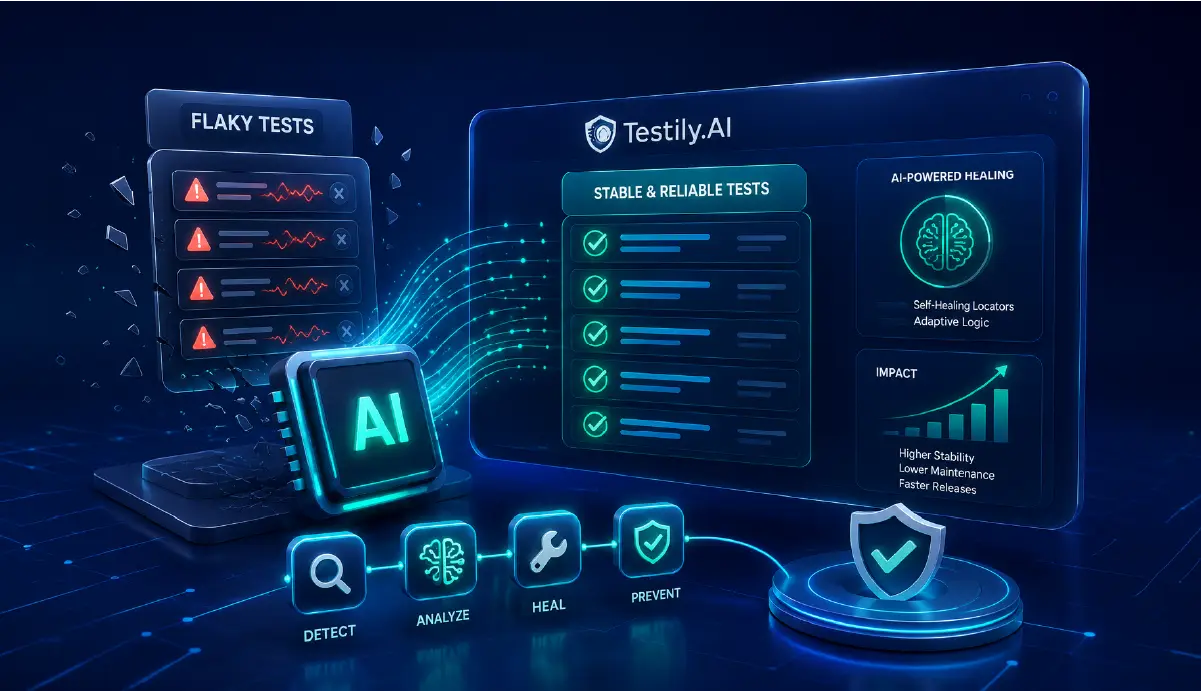
Testily.AI is designed specifically to address this challenge by helping teams reduce instability, minimize maintenance overhead, and keep testing scalable as products grow.
What AI Actually Changes in QA
AI testing does not remove QA work completely. What it changes is the amount of repetitive effort required to maintain testing systems. Modern AI-driven platforms like Testily.AI helps teams:
- Reduce flaky test behavior
- Adapt to UI and workflow changes
- Detect instability patterns earlier
- Minimize manual script updates
- Improve CI/CD reliability
- Reduce repetitive debugging work
This is where measuring the ROI of AI in QA teams starts becoming much more practical. Because the value becomes visible in everyday workflows:
- Faster releases
- Less maintenance effort
- Reduced pipeline interruptions
- Higher trust in automation
- Better engineering productivity
And over time, those operational improvements create measurable ROI.
The Real Areas Where Teams See ROI
1. Reduced Test Maintenance
This is often the first major improvement teams notice after adopting AI-driven testing platforms like Testily.AI. Instead of constantly fixing broken scripts after every product update, teams spend less time maintaining automation and more time improving quality. For many organizations, reduced maintenance effort becomes one of the clearest indicators when measuring the ROI of AI in QA teams. Because maintenance is where large amounts of hidden QA effort usually sit.
2. Faster Release Cycles
Unstable pipelines create delays everywhere. Tests fail unexpectedly. Builds get rerun. Teams pause deployments to investigate whether failures are real. Over time, that friction slows down delivery significantly. Testily.AI helps reduce this friction by improving test stability and reducing unnecessary failures inside CI/CD pipelines.
As pipelines become more reliable:
- Releases move faster
- Teams rerun builds less often
- Feedback loops improve
- Delivery becomes more predictable
That operational speed is another major factor in measuring the ROI of AI in QA teams.
3. Better Use of QA Resources
A surprising amount of QA effort is often spent on repetitive operational work:
- Fixing broken tests
- Updating scripts
- Rechecking unstable failures
- Managing automation noise
When platforms like Testily.AI reduce that maintenance burden, QA engineers can focus more on the following:
- Risk analysis
- Product quality
- Exploratory testing
- Release confidence
- Strategic validation
This improves overall team productivity without requiring teams to continuously increase testing resources.
4. Improved Confidence in Automation
One of the hidden costs in QA is uncertainty. When teams stop trusting automation:
- Pipelines get rerun repeatedly
- Manual validation increases
- Releases slow down
- QA becomes reactive
That lack of confidence creates operational drag across the entire delivery process. Testily.AI helps teams restore confidence by reducing flaky behavior, improving automation reliability, and making test outcomes more trustworthy. That improvement becomes another critical area when measuring the ROI of AI in QA teams.
Why Measuring ROI of AI in QA Teams Matters More Today
Modern software teams release constantly. Testing systems are larger. Automation suites are more complex. CI/CD pipelines run continuously. Without improving efficiency, QA effort naturally scales upward with product complexity. That’s why more companies are now prioritizing measuring the ROI of AI in QA teams because testing is no longer just a technical activity.
It directly impacts:
- Engineering productivity
- Release velocity
- Operational costs
- Delivery confidence
Platforms like Testily.AI helps address these growing challenges by reducing the operational overhead required to maintain stable testing workflows at scale.
What Many Teams Miscalculate About ROI
One common mistake is assuming ROI only means:
- Lower headcount
- Fewer QA engineers
- Reduced manual testing
But that’s not how most successful teams measure value. The real ROI usually comes from:
- Reduced maintenance effort
- Faster release cycles
- Improved stability
- Less debugging time
- Higher automation reliability
- Better engineering focus
Testily.AI supports this by helping teams eliminate repetitive maintenance work instead of replacing the human side of QA. Because the biggest value in AI testing often comes from reducing operational friction, not eliminating people.
Where Testily.AI Fits Into This
This is exactly where Testily.AI becomes valuable for modern QA teams. Instead of simply increasing automation volume, Testily.AI focuses on making testing easier to maintain, easier to trust, and easier to scale.
With Testily.AI, teams can:
- Reduce flaky test instability
- Minimize repetitive maintenance effort
- Adapt to UI and workflow changes automatically
- Improve CI/CD pipeline reliability
- Combine AI-powered automation with manual testing workflows
- Reduce time spent debugging unstable tests
This makes measuring ROI of AI in QA teams much more tangible because teams begin seeing improvements across:
- Release speed
- QA efficiency
- Pipeline stability
- Maintenance effort
- Overall engineering productivity
Rather than just test execution numbers.
The ROI Usually Appears Gradually
Most teams don’t experience instant transformation. The changes usually begin with smaller improvements:
- Slightly fewer test failures
- Less time spent fixing scripts
- Faster pipeline execution
- Reduced QA noise
But over time:
- Releases become smoother
- Automation becomes more reliable
- Teams stop constantly rerunning pipelines
- QA stops feeling like operational overhead
And eventually, the value becomes difficult to ignore. That’s when measuring ROI of AI in QA teams becomes less theoretical and more operationally visible inside everyday workflows.
AI in QA Is Really About Reducing Friction
The biggest misconception about AI testing is that it’s only about speed. In reality, the strongest ROI usually comes from reducing friction.
When testing becomes the following:
- Easier to maintain
- More stable
- Less dependent on manual fixes
- More reliable inside CI/CD
Everything around software delivery improves naturally. That’s exactly the kind of long-term operational improvement teams evaluate when measuring ROI of AI in QA teams, and that’s the problem, Testily.AI is built to solve.
A Practical Next Step
If your QA effort keeps increasing with every release, the issue may not be lack of coverage; it may be the growing effort required to maintain testing itself. The teams seeing the strongest ROI today are not necessarily testing more. They’re reducing the maintenance burden around testing while improving reliability at the same time. That’s where platforms like Testily.AI makes the biggest impact.
By helping teams reduce instability, improve automation reliability, and simplify testing operations, Testily.AI allows QA to scale without continuously increasing effort.
→ Book a demo to see how Testily.AI improves QA efficiency.
→ Explore how Testily.AI reduces maintenance overhead and accelerates releases