

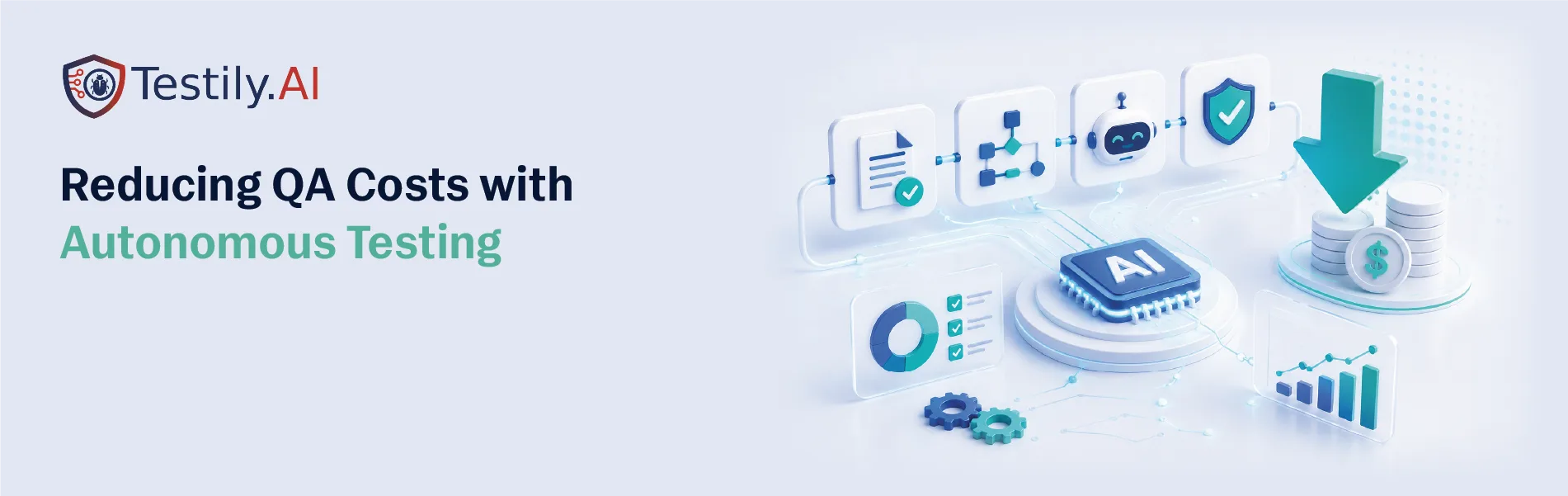
Reducing QA Costs with Autonomous Testing
QA costs don’t usually look like a problem at first. They build up slowly. A few extra hours fixing tests. A few more reruns in CI/CD. A little more effort maintaining scripts. Individually, it feels manageable. Together, it becomes expensive. That’s where reducing QA costs with autonomous testing starts to make real sense, not as a cost-cutting trick, but as a way to stop unnecessary effort from piling up.
Where QA costs actually come from
Most teams assume costs come from tools or team size. But that’s rarely the real issue. Costs usually come from:
- Constant test maintenance
- Debugging flaky failures
- Rewriting broken automation
- Delayed releases due to unstable pipelines
And the biggest problem? These aren’t one-time costs. They repeat every sprint.
Why traditional automation increases cost over time
Automation is supposed to save money, and initially, it does. But as systems evolve:
- UI changes break scripts
- Workflows shift
- Tests require constant updates
So instead of reducing effort, automation starts demanding attention. That’s when QA costs stop being predictable.
What changes with autonomous testing
Autonomous testing doesn’t remove testing. It removes unnecessary effort around testing. Instead of constant manual fixes, systems start.
- Adapting to UI changes
- Identifying flaky patterns
- Reducing repetitive maintenance
- Keeping tests aligned with product changes
That’s how reducing QA costs with autonomous testing actually happens by cutting down repeated work.
Where Testily.AI fits into this
This is exactly where Testily.AI becomes practical, not theoretical. Instead of teams constantly reacting to broken tests, Testily.AI helps by:
- Automatically adapting to UI and flow changes so scripts don’t break every time something shifts.
- Identifying flaky behavior across runs so teams don’t waste time guessing.
- Reducing manual test maintenance through self-healing capabilities.
- Keeping test suites aligned as the product evolves.
The goal isn’t to replace your current setup. It’s to remove the parts of QA that keep adding cost without adding value.
What cost reduction looks like in real terms
Not “cutting budgets.” Not “reducing QA teams.”
But:
- Less time fixing broken tests
- Fewer reruns in pipelines
- Lower maintenance overhead
- Faster, more predictable releases
In simple terms: You stop paying for the same problem again and again.
What this looks like over time
At first:
- Slightly fewer failures
- Slightly less maintenance
Then:
- Stable automation
- Predictable QA effort
And eventually, QA stops feeling expensive because it stops being inefficient.
Conversion-focused close
If your QA effort keeps increasing without clear returns, it’s usually not a tooling problem; it’s a maintenance problem, and once you reduce that, everything else improves. If you want to see how teams are actually reducing QA costs in real workflows, it’s worth exploring how Testily.AI fits into your current process.