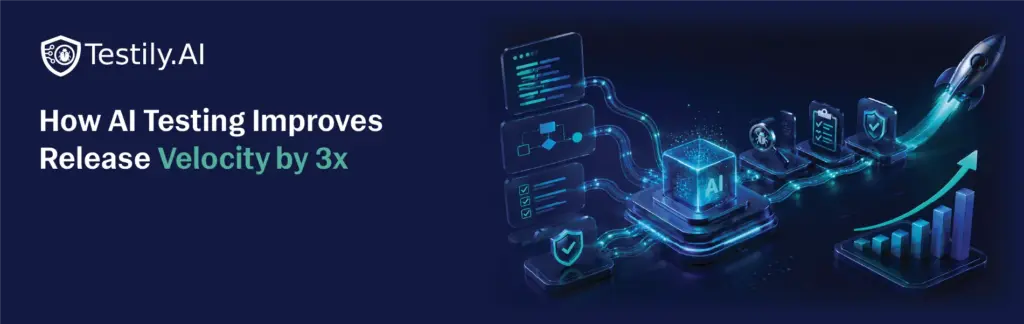
How AI Testing Improves Release Velocity by 3x

How AI Testing Improves Release Velocity by 3x Most SaaS teams aren’t slow at building things. They’re slow at releasing them. Because somewhere between “this is ready” and “this is live,” things start slipping. A test fails. Someone reruns the pipeline. Another failure shows up. Now it’s unclear if it’s real… or just noise, and before anyone realizes it, something that should’ve gone out in hours takes days. That’s exactly where AI testing improves release velocity by 3x, not by making developers faster, but by removing the friction that quietly slows everything down. Where release velocity actually gets lost It’s rarely one big issue. It’s a collection of small interruptions that keep repeating: tests failing without clear reasons, time spent fixing broken scripts, rerunning builds just to “confirm” stability, and manual effort to keep automation working. Individually, none of these feel critical. Together, they create drag. That’s why many SaaS teams don’t say, “We have a velocity problem.” They just feel like releases take longer than they should. Why automation alone stops working at scale Automation does help at least in the beginning. You remove repetition. You speed up execution. But then things change. UI updates break tests. Flows evolve faster than scripts. Maintenance becomes constant, and now, instead of saving time, automation starts adding overhead. That’s one of the most common test automation challenges SaaS teams run into. What changes with AI testing This is where the shift happens. AI testing doesn’t just execute tests; it reduces the effort around them. It helps by adapting to small UI and workflow changes. reducing flaky failures, cutting down manual maintenance, and giving clearer signals on what is actually broken, and that’s the real reason AI testing improves release velocity by 3x because teams stop wasting time fixing tests and start trusting them again. What “3x faster” actually looks like Let’s keep this real. Before AI testing: A test fails → investigation starts Script gets fixed → pipeline reruns Still not sure → rerun again The release gets delayed After AI testing: Fewer unnecessary failures Faster identification of real issues Minimal test maintenance Pipelines move forward without constant interruption Nothing magical. Just less friction, and that’s where the 3x improvement actually comes from. Where SaaS teams feel the impact first 1. Pipelines stop getting stuck Stable tests mean CI/CD testing flows instead of constantly pausing. 2. Less time fixing automation Teams stop babysitting scripts and start focusing on quality. 3. Faster feedback loops Developers get clearer, quicker signals so decisions happen faster. 4. More confidence in releases When tests are reliable, teams don’t second-guess every failure, and that alone removes a surprising amount of delay. Why this matters more in SaaS than anywhere else SaaS teams don’t release occasionally. They release constantly. Which means even small delays compound fast. A few extra hours per release → become days over time. That’s why the idea that AI testing improves release velocity by 3x isn’t just about speed—it’s about staying competitive. What teams usually get wrong When releases slow down, the instinct is to add more tests, increase automation coverage, and run more pipelines, but more doesn’t mean faster. If the system itself isn’t stable, you’re just scaling inefficiency. The real shift happens when teams focus on the following: a. reducing maintenance b. improving reliability c. eliminating unnecessary failures That’s where AI in testing actually starts delivering ROI. What this looks like over time At first, the improvement feels small. Slightly fewer failures. Slightly smoother pipelines. But over time: 1. releases become predictable 2. reruns become rare 3. QA stops feeling like a bottleneck And that’s when AI testing improves release velocity by 3x in a way that actually feels real. Where Testily.AI fits into this This is where tools like Testily.AI starts making a practical difference. Not by replacing your setup but by reducing the friction inside it. Instead of constantly fixing tests, teams can let tests adapt to small changes. Reduce flaky failures automatically and spend less time on maintenance, and that’s what actually improves release velocity: not more testing, but smoother testing. It’s not about speed. It’s about removing friction. Most teams think they need to move faster. But in reality, they just need fewer interruptions. Because once the friction is gone, speed follows naturally. That’s what people really mean when they say AI testing improves release velocity by 3x. If releases keep getting delayed… …it’s usually not because your team is slow. It’s because something in the process is creating drag, and more often than not, that drag comes from testing. If you want to see what smoother, faster releases actually look like in practice: → See how reducing test maintenance changes release speed → Or explore how AI testing fits into your current CI/CD workflow FAQs 1. How does AI testing improve release velocity by 3x? By reducing test failures, minimizing maintenance, and keeping pipelines moving without interruptions. 2. Is AI testing better than traditional automation? It complements automation by making it more stable and less maintenance-heavy. 3. Does this apply to all SaaS teams? Yes, especially teams with frequent releases and growing complexity. 4. What’s the biggest benefit? Less time fixing tests, more time shipping features. 5. Is it difficult to implement? Most teams start small, focusing on high-maintenance areas first.