The Future of QA: Will AI Replace Testing Engineers?
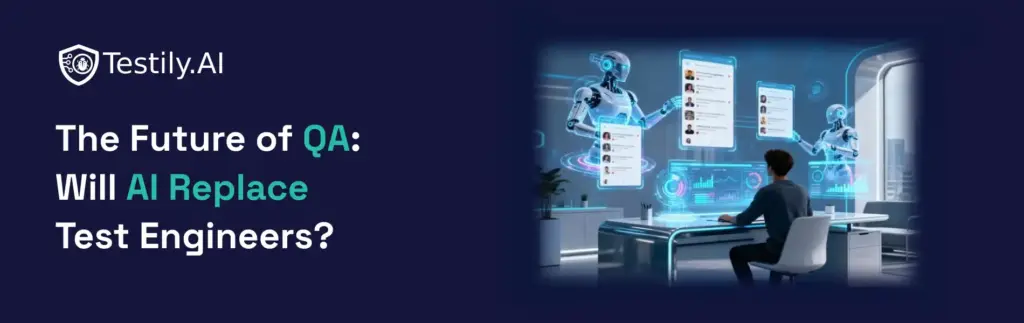
This question keeps coming up and not without reason At some point in almost every team, this question shows up: “Will AI replace testing engineer?” It usually comes up when something shifts. Maybe a new tool starts generating test cases. Maybe automation suddenly handles more than expected. Or leadership starts talking about efficiency, and honestly, it’s a fair question. Because when AI starts doing work that used to take hours, any testing engineer is going to wonder what that means for their role. The short answer: no… but the role is definitely changing Let’s get this out of the way. AI is not replacing the testing engineer. But the job itself? That’s evolving. What’s really happening is not replacement; it’s redistribution. Some tasks disappear. Some become faster, and some become far more important than before. That shift is what people are actually noticing. Why this question even feels real If you look at how QA has evolved, the concern makes sense. We’ve moved through clear stages: Manual testing → everything done step by step Automation → scripts take over repetition AI-driven testing → systems start adapting on their own So naturally, the question becomes, “If tools can now create and maintain tests… what’s left for a testing engineer?” What AI is genuinely good at Let’s be honest: AI in testing is impressive. It can: generate test cases quickly run tests continuously detect patterns in failures adjust when UI changes reduce repetitive maintenance If you look only at this, it can feel like the role of a testing engineer is shrinking. But that’s only half the picture. What AI still can’t do and this part matters more This is where things become clearer. AI can execute tasks. But it doesn’t really understand the product. It doesn’t: question whether a feature actually makes sense think like a frustrated user prioritize what’s risky vs what’s safe understand business impact decide what “good quality” actually looks like And that’s where a testing engineer becomes essential. Because testing isn’t just execution. It’s judgment. So what actually changes for a testing engineer? The role doesn’t disappear; it moves upward. Instead of spending time on repetitive execution, a testing engineer starts focusing on: test strategy risk analysis edge-case thinking product-level quality decisions In simple terms: AI takes care of the predictable work. Humans handle the thinking. What this looks like inside real teams When teams start using AI-driven testing, the change is subtle at first. You notice: fewer scripts to fix fewer repetitive test runs less time spent debugging noise And slowly, the testing engineer becomes less of an executor… and more of a decision-maker. You’re no longer just validating features. You’re shaping how quality is defined. Where are tools like Testily.AI fit into this shift This is where platforms like Testily.AI actually make sense. Not because they replace a testing engineer but because they remove the parts of the job that don’t need human effort. With Testily.AI, teams can: generate and maintain tests without constant rewriting reduce time spent fixing unstable automation adapt to changes without breaking everything keep testing aligned with fast-moving development Which means the testing engineer gets to focus on what actually matters: thinking, analyzing, and improving product quality. We’ve seen this pattern before This isn’t the first time QA has gone through a shift. When automation became common, people assumed manual testers would disappear. They didn’t. They adapted. The same thing is happening now. The tools are evolving, but the role of a testing engineer is evolving with them. So… will AI replace testing engineers? No. But it will absolutely change: how a testing engineer works what they spend time on where they add value And in most cases, that change makes the role stronger, not weaker. QA isn’t going away; it’s growing up The future of QA isn’t about AI vs humans. It’s about collaboration. AI handles: repetition execution maintenance Humans handle: judgment context product thinking And when that balance works, the role of a testing engineer becomes more important — not less. If you’re thinking about this… you’re already on the right track If this question has come up in your team, it usually means something is already changing. Maybe testing is becoming faster. Maybe automation is growing. Maybe maintenance is becoming a problem. That’s exactly the point where exploring AI starts making sense. Not to replace your team but to remove the effort that slows them down. FAQs 1. Will AI replace testing engineers in the future? No. AI will automate repetitive tasks, but a testing engineer is still needed for decision-making, strategy, and quality evaluation. 2. What does AI do in testing today? AI helps with test generation, execution, maintenance, and identifying patterns faster than traditional methods. 3. How is the role of a testing engineer changing? It’s shifting from execution toward strategy, risk analysis, and product-level quality thinking. 4. What is autonomous testing? Autonomous testing refers to systems that can create, run, and update tests with minimal human input. 5. Will automation make testing engineers obsolete? No. It reduces manual effort but increases the importance of human expertise. 6. What skills will testing engineers need going forward? Stronger focus on product understanding, test strategy, automation tools, and working alongside AI systems.