

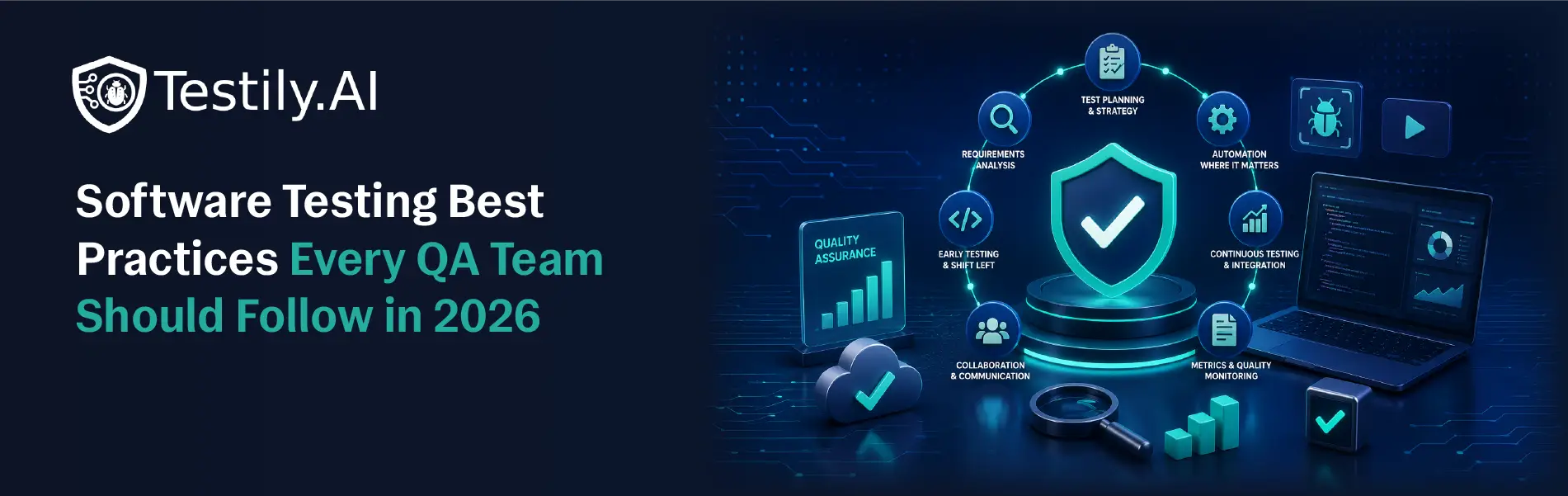
Software Testing Best Practices Every QA Team Should Follow in 2026
You’ve read a version of this list before. “Write test cases early.” “Automate where possible.” “Test early and often.” Every one of those is technically true, sure, and none of them tells you anything you didn’t already know at 2am during a release you’d rather forget.
So here’s an attempt at something more useful, software testing best practices pulled from what actually happens on real teams, with honest notes on where things usually go wrong, and where a tool like Testily.AI takes the repetitive part off someone’s plate. Call it QA best practices with the theory stripped out and the day-to-day reality left in.
Start Before Any Code Even Exists
This one, more than anything else, separates teams that ship confidently from teams that ship and then brace for impact. If you wait until a feature’s built before writing test cases, you’re always playing catch-up. By then the architecture’s locked in, and any design flaw you find is expensive to unwind.
Shift-left testing means reviewing requirements, user stories, and acceptance criteria for gaps before a single line of code gets written. Catches ambiguity while it’s still cheap. A requirement that says “users should be notified” without saying how is a question for planning, not something you want to discover as a live bug in three weeks. Testily.AI helps here directly, generating test cases straight out of your BRDs and user stories, so vague requirements get flagged the moment they’re written instead of buried mid-sprint.
Prioritize by Risk. Not by What’s Easiest to Test First.
Not every feature deserves equal attention. Payment processing, login, anything touching user data, and real consequences if those break. A cosmetic tweak on a settings page three people ever visit. Not so much.
And yet, a lot of teams test in whatever order feels most comfortable, knocking out the easy stuff first, then racing through the genuinely risky areas once the deadline’s already breathing down their neck. Flip that. Rank by business impact and failure likelihood, then test accordingly. Testily.AI keeps this consistent automatically, tying every generated test case back to the requirement it came from, so the high-stakes stuff doesn’t quietly end up at the bottom of a to-do list nobody’s looking at anymore.
Every Test Case Should Trace Back to Something Real
Every test case ought to map to a specific requirement or user story. Skip that, and two things go wrong pretty fast: you can’t answer “did we actually test this?” when a stakeholder asks, and old tests for features that don’t even exist anymore just sit there, eating up execution time on every single run for no reason.
Traceability also speeds up impact analysis a lot. A requirement changes, and you know instantly which tests need a second look, no guessing, no re-running the whole suite out of nervousness. This is more or less built into Testily.AI from the ground up. Every generated test links to its source requirement, so when the spec moves, the tests move with it instead of quietly falling out of sync somewhere in a shared drive nobody checks.
Automate the Boring, Repetitive Stuff, Not Everything
Automation gets treated like a magic fix, and blindly automating every single test case is exactly how teams end up regretting it. Repetitive, stable, high-volume tests; regression; smoke; and data validation are great automation candidates. Exploratory testing, usability calls, anything needing actual human judgment? Not really.
Teams that go all-in on automation without thinking it through end up babysitting a pile of brittle scripts that snap the moment a UI element shifts three pixels. More time gets spent fixing tests than the manual approach would’ve ever taken. Testily.AI is built for exactly the repetitive layer, regression, smoke, and validation, generated and run without anyone touching it, which frees up actual humans for the exploratory work machines still cannot do.
Flaky Tests Are a Bug. Treat Them Like One.
A test that fails randomly, with no clear reason, is one of the fastest ways to destroy trust in a whole suite. The moment people start saying, “Oh, that one’s just flaky; ignore it,” you’ve basically lost the entire point of automated testing. A red result is supposed to mean something.
Fix flaky tests immediately or pull them out until they’re fixed; don’t let them linger. A suite nobody trusts is arguably worse than having no suite at all, because it gives you false confidence instead of none. Testily.AI builds and maintains tests straight from requirements rather than fragile hand-coded UI scripts, so a lot of that flakiness, the kind caused by a button moving slightly, just doesn’t show up in the first place.
Don’t Split Functional and Non-Functional Into Separate Phases
It’s tempting to push performance, security, and usability testing into “later, once things settle.” Things rarely settle on schedule, and those non-functional issues just quietly make it to production instead. Build them into the same pipeline as functional testing from day one. Testily.AI generates both from the same requirements set, so this stops being a separate initiative somebody has to remember to plan for.
Take Test Data Seriously
Bad or inconsistent test data causes way more flaky, unreliable testing than people give it credit for. Tests leaning on old production data copies, hardcoded values, or a spreadsheet somebody updates every so often break the second anything upstream shifts. Real synthetic test data, generated and version-controlled the same way you’d treat actual code, removes a surprisingly large chunk of false failures. Testily.AI factors realistic data into what it generates, cutting out a lot of manual spreadsheet wrangling that usually lands on whoever’s newest on the team.
Prune Your Test Suite. Regularly. On Purpose.
Test suites grow. They basically never shrink by themselves. Give it enough time and you’ve got tests for features that got killed months ago, duplicate coverage scattered across different suites, and cases where nobody remembers what they were even for. Left alone, this slows everything down and buries real failures in noise. A quarterly cleanup, prune, consolidate, and update keeps things lean. Because Testily.AI ties every test to a live requirement, a retired or changed requirement naturally flags which tests have gone stale. Nobody has to go digging for it manually.
Let the Requirements Drive Test Creation
This is really where most of the software testing best practices above start to converge, and it’s the part of the industry moving fastest right now. Hand-writing test cases from requirements is slow, inconsistent from tester to tester, and misses edge cases more often than anyone likes to admit. Any solid list of software testing best practices eventually lands here: let the requirements do the driving, not a tester’s memory. Testily.AI generates test scenarios directly from BRDs, user stories, and acceptance criteria, keeping everything traceable automatically, adapting as specs change, without someone rewriting scripts by hand every sprint.
To be clear, this isn’t about cutting humans out of testing. It’s about clearing away the repetitive parts so testers get to spend time on judgment calls and edge cases, the stuff a machine still needs a human pointing it toward.
Track What Actually Matters, Not Just What Looks Good
Test count and pass rate don’t mean much on their own if you’re not also tracking defect escape rate, time to detect, and coverage against real business needs. A suite with 2,000 green checkmarks that still lets critical bugs through to production isn’t a win, no matter how the dashboard looks in a stakeholder meeting. The ISTQB Foundation glossary makes roughly the same point about coverage: it was never about volume; it’s about confidence that the right things got checked. Testily.AI‘s requirement-level traceability makes reporting against actual business goals a lot easier than pulling a raw test count and hoping it tells the story.
Putting It All Together
None of these software testing best practices really work in isolation, if I’m honest. Shift-left without risk prioritization just means testing everything early instead of everything late. Automation without flaky-test discipline just automates the mess faster. The real payoff shows up when these software testing best practices function as one connected system instead of a checklist you complete once and never revisit, which is more or less the whole premise behind Testily.AI, rather than a stack of separate tools duct-taped together.
If you’re building out a broader QA strategy, use Testily.AI‘s blog has a few more posts worth reading, including how this connects to functional versus non-functional coverage specifically.
Ready to Put These Practices on Autopilot?
If your team’s still translating every requirement into test cases by hand, that’s usually the first bottleneck worth fixing. Testily.AI generates, traces, and maintains your test suite directly from your requirements, so traceability, risk-based prioritization, and full functional-plus-non-functional coverage happen automatically instead of depending on someone remembering to do it every sprint.
Book a free Testily.AI demo and see how much of this your QA team could hand off starting next sprint.