


AI Test Automation Tools: Why More Teams Are Changing How They Test
A few years ago, most teams were excited just to automate testing, and honestly, that made sense. Manual regression cycles were exhausting. Repetitive testing consumed entire sprints. Automation looked like the obvious answer. For a while, it worked exactly the way teams hoped it would. Then products became larger. Releases became more frequent. Interfaces changed constantly, and suddenly the thing that was supposed to save time started demanding more of it. That’s usually the moment teams begin seriously looking at AI test automation tools. Not because automation stopped working. Because maintaining automation started becoming its own full-time problem.
Most Teams Don’t Notice the Problem Immediately
Early automation rarely feels difficult. At smaller scale, everything feels manageable:
- Fewer workflows
- Fewer dependencies
- Fewer test cases
- Fewer release cycles
Even fragile automation can survive for a while in that environment. The pressure builds slowly. One release introduces UI updates. Another changes workflows. A third adds integrations. Then the test suite starts reacting to all of it. A selector breaks here. A flow changes there. A previously stable script suddenly fails for no obvious reason. At first, teams treat these as isolated annoyances. Over time, they realize they’re spending more energy maintaining testing than benefiting from it. That’s one of the biggest reasons AI test automation tools are becoming more relevant now.
The Real Cost of Automation Shows Up Later
Writing automation is usually not the hardest part. Keeping it healthy is. That’s the part most teams underestimate. Every automated test quietly creates future work:
- Updates
- Validation
- Debugging
- Reruns
- Maintenance
- Environment Adjustments
None of this looks dramatic on its own. But together, it creates a system that constantly asks for attention. This is where platforms like Testily.AI starts becoming valuable, not because they eliminate testing effort completely, but because they reduce how much ongoing maintenance the system requires to stay usable.
Why Traditional Automation Starts Feeling Heavy
The issue isn’t that traditional automation is “bad.” A lot of teams still rely on it successfully. The problem is that most traditional frameworks depend heavily on stability. Modern products are rarely stable in that way anymore. Interfaces evolve constantly. User journeys shift. Business logic changes faster than automation frameworks can comfortably absorb.
That creates a cycle most QA teams recognize:
- Something changes
- Tests break
- Someone investigates
- Scripts get updated
- Pipelines rerun
- Confidence drops slightly
Then the same thing repeats next sprint. Eventually, the system starts feeling heavier than expected. That’s where AI test automation tools are changing the conversation.
AI Testing Is Really About Adaptability
A lot of people hear “AI testing” and imagine fully autonomous systems replacing QA teams. That’s usually not what teams actually need. The practical value is much simpler. Adaptability. Modern AI test automation tools are designed to handle change more naturally:
- Recognizing UI shifts
- Identifying unstable behavior
- Reducing repetitive fixes
- Helping teams maintain reliable coverage
- Minimizing fragile automation patterns
The important shift isn’t just faster testing. It’s less operational friction around testing. That difference matters more than most teams expect.
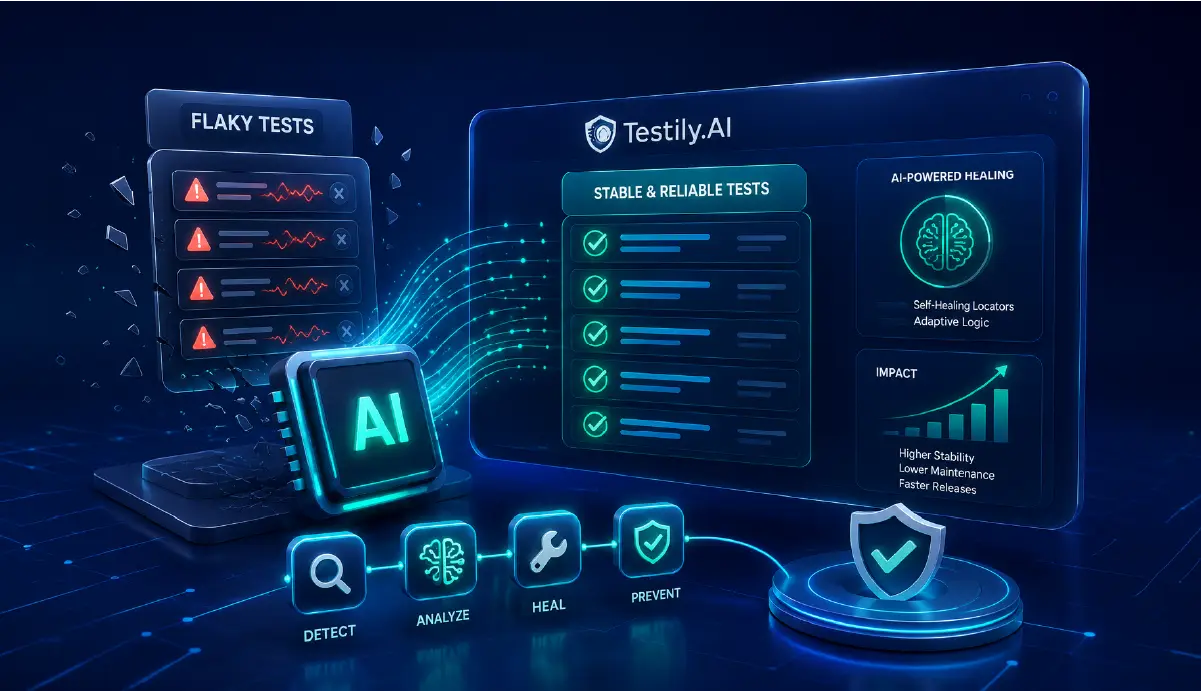
Flaky Tests Are Often the Breaking Point
There’s one issue that consistently pushes teams toward newer testing approaches. Flaky tests. Almost every engineering team has experienced this: A test fails. Nobody touched the code. Someone reruns it. Now it passes. At first, teams tolerate it. Later, it starts damaging trust.
People begin second-guessing failures:
- “Is this real?”
- “Should we rerun it?”
- “Maybe the pipeline glitched.”
That hesitation creates delay everywhere. Releases slow down. Confidence drops. QA becomes reactive instead of reliable. This is one of the biggest areas where AI test automation tools help in practical ways. Platforms like Testily.AI helps teams identify unstable patterns earlier so pipelines become more predictable and require less manual intervention.
Faster Releases Changed the Pressure on QA
Modern delivery cycles are very different from what most testing systems were originally built around. Teams now release:
- Continuously
- Weekly
- Daily
- Sometimes multiple times a day
That pace changes everything. Testing systems that require constant manual upkeep struggle under continuous release pressure. The issue usually isn’t execution speed. It’s the operational overhead around keeping testing stable while the product keeps evolving. That’s why more organizations are investing in AI test automation tools now. Not because AI sounds impressive. Because maintaining older testing workflows at scale is becoming harder every year.
The Goal Isn’t More Automation
This part is important. A lot of teams already have plenty of automation. What they actually need is:
- Less maintenance
- Fewer interruptions
- More stability
- Better confidence in results
More tests alone don’t solve that. Sometimes they make it worse. The strongest QA systems are usually not the biggest ones. They’re the ones teams trust consistently. That’s one of the reasons platforms like Testily.AI focus heavily on reliability and maintenance reduction rather than simply increasing test volume.
QA Engineers Still Matter More Than Ever
AI tools are improving quickly. But they still cannot:
- Understand business priorities
- Evaluate product risk
- Think like frustrated users
- Decide what quality actually means
- Replace exploratory thinking
That’s still human work. What AI test automation tools do well is remove repetitive operational effort so QA teams can spend more time on higher-value decisions.That shift is already happening across modern engineering teams. Not replacement, but redistribution, and honestly, most QA engineers prefer that direction.
What Teams Usually Notice After the Shift
Interestingly, the first improvement usually isn’t “faster testing.” It’s lighter workflows. Teams notice:
- Fewer reruns
- Fewer broken scripts
- Fewer noisy failures
- Less time fixing automation
- Smoother release preparation
Gradually, the entire release cycle starts feeling less tense. That operational calm is usually the real sign the testing process is improving.
Why This Shift Will Keep Growing
Software delivery is not slowing down. If anything, products are becoming the following:
- More connected
- More dynamic
- More continuously updated
Which means testing complexity keeps increasing too. The teams that scale successfully won’t necessarily be the ones with the largest automation suites. They’ll probably be the ones that reduce maintenance overhead most effectively. That’s exactly why AI test automation tools are becoming such an important part of modern QA conversations.
How Testily.AI Helps
Testily.AI helps teams reduce the operational burden that usually grows around testing over time. Instead of constantly fixing fragile automation, teams can:
- Reduce repetitive maintenance work
- Improve test reliability
- Minimize flaky behavior
- Adapt faster to product changes
- Maintain stable testing workflows
- Improve release confidence
The goal isn’t replacing QA. It’s making testing easier to sustain as products continue growing.
Final Thoughts
Most QA problems today are not caused by lack of testing. They come from the growing effort required to maintain testing systems. That’s the real reason teams are moving toward AI test automation tools. Not because they want futuristic automation. Because they want testing processes that don’t become heavier every time the product evolves, and for many teams, that shift is already becoming necessary rather than optional.